UA-141369524-4

Centering – From Loss to Happiness

There are situations and times in life where you get to re-evaluate your current life.

There’s always a good side to most situations, the way I see it.

…And that helps the situation and  happiness.

…Maybe that’s how you approach life? Or if it’s a newer concept for you to consider to adopt, keep reading as I share more of my insight on this…

Because every situation is an experience, and is also a learning experience.

The experience is either sweet or bittersweet. But not totally bitter if you have a habit of better perspectives.

…Even in the sour situations where it feels like life is pitted against you from several angles.

Those times are simply tests that if you pass (or get past them as time will do), you become a better person on the other side.

Because life is rigged in your favor.

You come out better on the other side of the storms.

Sometimes getting through takes weeks, months, year, or even decades.

But in the process, for one, you learn how to navigate the stings and difficult situations better for the next time around… whether they are the same or similar situations.

Or you get to help others through their situation, that’s healing for you as well.

Because similar (test) situations often do boomerang back around.

And you get a chance to pass again with flying colors or go through just a ‘lil better than the first or last time when you were possibly blindsided (or in shock).

You become more experienced (and wise if you choose).

And if you look at it that way, no situations are wasted. They help you advance in life… and grow wiser toward your finish line.

And that’s a great goal. 🎯

Stressful or sad situations help you chill out and not sweat the small stuff as much.

You get to learn to let go that can be a long lesson to learn in life, like it was for me.

And to surrender to life, that’s an even longer lesson.

Lessons learned come from being tested.

And if you are, afterwards you get tobecome happier and less concerned with outcomes.

It all works out eventually. Or you work out your perspective.

And that’s your choice whether you want to experience that type of happiness. And sometimes peace.

You decide what perspective you take.

Like in this picture window… you have a choice to focus more on the  ornate artful sides or the green landscape?

I first see the ornate artwork in this season of mine.

And you see what’s drawing you in now.

The greenery is real and part of this summer season we’re in.

…And it was during this time that I experienced family loss.


I was provided a bittersweet and sometimes sour situation, and was able to see how to appreciate each day even more from a different lens…

And that season I took to my now-happier season and surroundings.

And you can too.

…Starting with the things in your home.

You and I get to make changes, decorate, or minimize decor.

And that helps you to not let things get stale in how they are viewed.

Because the alternative is getting used to the sights and sounds around you…  and that is not living appreciatively when you don’t see or hear attunely anymore to those gotten-used-to things.

That naturally happens over time, and is how this life is… and also the way we’re wired to see and feel unless we do something to snap out of those stale default ways.

The opposite way that you can activate is by appreciation. This allows you to fill up with gratitude, and that can easily carry over into other areas of your life with positive impact.

It’s a sensitized feeling that comes from humble meaning you put to your thoughts that affect your feelings.

Being sensitized and also changing up your unwanted or negative thoughts (about our situations), can 100% change your life today.

And that can start from finding passion in aspects of your life, like taking care of what you have.

Stewarding is managing what you have (and not taking for granted).

That way, one day you will pass what you’re still stewarding onto someone else or other people who will be the beneficiary.

As the benefactor, you can decide what you pass on. It’s a gift.

By finding things and assigning to people who would appreciate, you get to appreciate in the journey and in the meanwhile. That’s a complete winning score. It has a lasting effect. And you grow and get more.

Plus, the experiences you amass in the process, help to make you a better person. You can heal in breathing fresh air, or the feeling of closure and moving on.

Those moments can be peaceful and centering, like sitting in a waterfall centering room like this.

Where moments are experiences. And taking on living each day not wasted has new meaning. And that is a cleansing cathartic experience in itself.

Wherever you are, give it a go today! 🎉 You’ll be glad you did.
Best Anti-Inflammatory Spices – I Can’t Live Without (And You Shouldn’t Either)

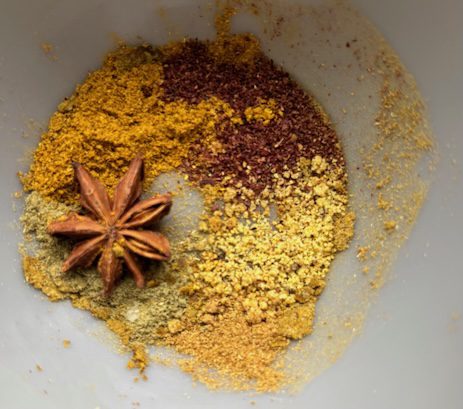
Anti-Inflammatory spices is something I can’t live without in modern living… they’re rainbow food-as-medicine. And nature’s supplements.

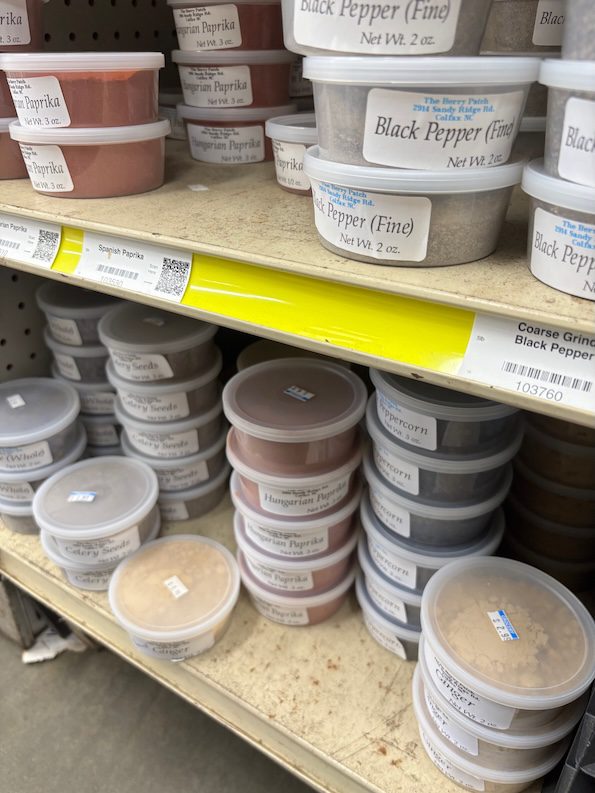
rainbow anti-inflammatory spices ready for a home blend.

They prevent conditions and in some cases, they natural Rx heal right away like medicine if you know what to take and when!

And they add cooking and baking flavor to dishes.

They’re also dirt cheap, comparatively. Even a $10 spice costs less than most medicines on insurance. They also don’t expire as soon as most pills.

You can tell it’s time to replace when the scent disappears if it had one to start with, because that’s a hint at its taste value and its healthiness… if that’s what you’re after.

Taste is subjective, but their effectiveness is not.

Anti-inflammatory spices aren’t good substitutes for fixing a health problem that needs medical attention.

But the right ones are often good for prevention, that doesn’t get talked about enough.

Sometimes you can dodge an infection bullet before it starts a war in the body. But once it grows, it’s too late for spices.

Where they would have been ideal to take, and are natural.

Spices don’t cause gut havoc.

They support restoring the body.

And that’s what Ayurvedic food-as-medicine is all about.

Plus, your body is your advocate as it knows what it needs.

It’s only downfall is it lacks communication.

Instead you have your senses to give you clues.

…And if you take a spice whiff and it smells good this season for you, then your body is telling you that’s good for you.

That’s obvious to us as we like what we like.

But it’s even more intuitive than that.

Your nose knows!

Being intuitive to supporting your good health, the body tells you what it is lacking by making it a preference to you. Remember, the body lacks communication skills, so it can’t straight up tell ya!

And that makes visiting spice stores and candle sections (that are also healing) all the more intriguing. I’ve been intrigued for decades.

Aromatherapy is good for wellness.

And with spices and herbs (the leaves) as aromatics in cooking, we’re off to a good start!

If we like how it smells, it’ll be even better when we get to taste what we’re making.

The taste buds will confirm that.

And we’re doing our body a world of anti-inflammatory good as most plant-based foods like spices and herbs have phytochemical, polyphenols. and antioxidants.

Which is why people all over the world use spices as medicine potions, and have been for centuries.

And this people, me, 😊 has spices in a third of her pantry… with food ingredients and tea filling the remaining space.

But I count teas sometimes as spice blends for baking. And if you look at each of your tea’s ingredients, you often find spice bits (like bits of plants from seeds, fruit, bark, or root). Chai is a great example. And you can use a tea bag to make no-bake dessert chai balls.

Others common ingredients include chicory and licorice roots. Or coriander and cumin seeds. And celery seed.

But teas make better answers for tea drinks or a cup of tea. Because the spice blends are often sweet and subtle.

Spices are usually as subtle, as they punch you in the face.

So you won’t find dill or cayenne often in a tea bag, because they’re not sweet. And mint tea is too subtle compared to fresh mint herb (leaves).

And if it’s too subtle, their culinary purpose is diminished. So if you’re taking turmeric or cayenne for (preventative) health reasons, look for fresh ones.

An exception is ginger. It plays well with sweet tastes like chocolate, so it’s good in a drink or gingerbread cookie (my preferred way 😋). .

Spices should come alive in scent on their own. Or in a spice blend (different than a tea with a blend of spices).

Today, out in markets you easily find spice blends like Five Spice (usually with cloves, star anise, Sichuan pepper, and fennel seeds, cinnamon) and garam masala (cumin, coriander, cardamom, cloves, cinnamon, and black pepper).

This is a short list of what I look for in spices for taste and food-as-medicine:

Capsaicin – found in some spices like paprika is the mild version of spices that have chili peppers like cayenne pepper. It’s especially noted as good for nerve damage.

Try a Cajun spice blend that has more than one kind of capsaicin spice like paprika and cayenne. Plus other healthy ingredients like black pepper, garlic, and onion. 5-in-1, gotta love that!

Cardamom – Baharat is a Lebanese 7-spice that brings me back to managing busy parties for some popular DC Lebanese restaurants. Often the blend has black pepper, paprika, nutmeg and the 5 C’s (cumin, coriander cinnamon, cloves, cardamom). Chai is another source.

Turmericcurcumin is so good for inflammation and joint pain. I have found so many good uses. It gets better and better. And the turmeric taste is smoky good for savory dishes that makes up for its pitfall as a spice that stains clothing.

Cloveseugenol is in an allspice with cloves. It’s more potent than in other spices like cinnamon. And that you can tell by the powerful smell and taste… making my point above as medicine is in the aroma strength. Cloves are noted as good for taming potential gum infections.

Gingergingerol is another punchy spice. Adding this to sweet tastes and drinks are easy ways to take in ginger. That the spice is known to be better at some things than whole ginger that can be too strong of a taste for some. And the spice is much easier to add than the awkward shaped ginger root.

Oreganothymol is found in many spices like thyme and is part of the mint family, but oregano has powerful antioxidants. It goes great in Italian dishes and a low-sodium healthy soup like clam chowder.

You can also go French bistro vibe with a Provencal or French blend that usually has parsley, chives, dill and tarragon at a minimum. And blends like this save time because it’s one spice instead of 4.

But you’re addicted to spices like me, you still have each of the spices on their own. 😁

You and I don’t have to wait for an occasion like Thanksgiving dinner spices to break out the anti-inflammatory spices. You can get in the healthy habit today.

Dyshidrotic Eczema – Printable Anti-Inflammatory Food List

Dyshidrotic eczema is a specific type of eczema marked by inflamed skin marks caused by dry skin triggers. It’s related to general atopic eczema and like a sunburn with dry skin and blisters. And these days have been more dry so it can happen more often.

But there’s more causal facts to the condition behind the hood than just dryness, where self-care is just part of the solution.

And if this is something you or others you care about face in life for weeks or seasons, then knowing how to shorten flareups (or better yet prevent them altogether) is the best happy daily life answer.

For starters, you can do something empowered about it with food-as-medicine!

…Where eat-from-the-rainbow foods are real skin medicine and cures in a bowl. 🥣

Healthy food is something I believe in wholeheartedly. And if I were to leave here tomorrow, I would not regret eating healthy foods at all, as I make them delicious (it’s in my former catering-self blood!).

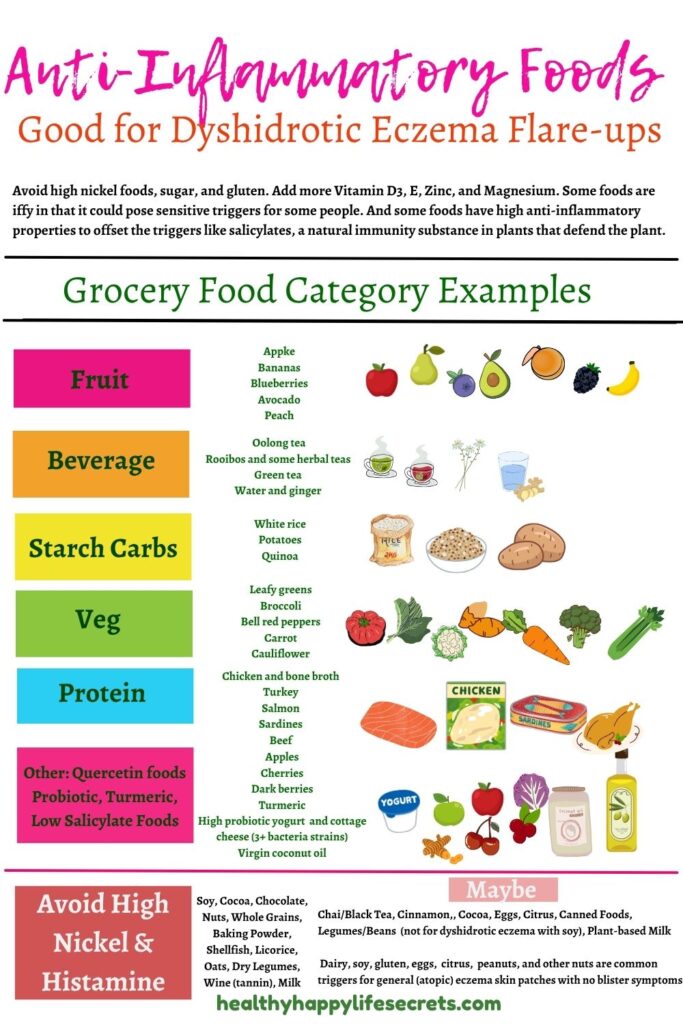
For dyshidrotic eczema, a starting anti-inflammatory food list like this specific one can be turned into a tasty menu!

dyshidrotic eczema printable grocery food list

This healthy good grocery food list is one you can print out for your grocery shopping. …And on this site, I always share what healthy flavors I pair and recipes so you can make them daily for your bowls and plates… and I mean daily, where the easy-to-source healthy foods do the heavy lifting as flavor and texture ingredients.

And where eczema symptoms are made better eating these anti-inflammatory foods (and worsened with unhealthy foods).

In the dyshidrotic eczema case, clear blisters are clear signs to this type of eczema caused often by environmental and/or genetic factors.

…Plus, a natural earth metal you’ll learn more about below. 👇

While flareups are temporary, an anti-inflammatory diet helps restore the inflammatory skin symptoms sooner, as long as you don’t itch-n-scratch.

And you do baby yourself in self-care and moisturize skin often like you would prioritize changing a diaper.

And as you gain experiences and grow, eczema of any sort gets easier along with your reflexes to help restore to normal.

I know this deeply as I entered this unknown with my first few eczema lessons. They looked slightly different, but had the same common skin inflammation at the core.

And since those early years, I’ve learned so much and about which food-as-medicines, help or hurt. I’m a talking and walking test case under the microscope.

And as life is changing so fast these days, I’m constantly adapting to and refining my options to the evolving ingredients that end up in processed grocery foods. And so should you!

And while sorting through which foods are good (in this ever-changing food landscape), may be overwhelming, the silver lining is you get to build a good relationship with anti-inflammatory healthy foods that you might not otherwise have put in your cart.

You get to healthy eliminate and re-evaluate.

You wise up to what certain healthy foods that are good… but that you don’t want to eat too much of…

…Like go-to plant-based foods that are healthy in general, but (downer alert) come with natural negative plant baggage.

And more on that below, so you can focus on the positive foods!

Variety and moderation is still the best general answer.

Being more food and ingredient selective is also a healthy opportunity to detox, lose weight, and eat more fiber.

Wild salmon, lean chicken, white rice, sweet potatoes, turmeric, bananas, berries, probiotic Greek yogurt, honey, and bell peppers are examples of my good food-as-medicine, any day, year-round, any time and any condition.

These were good footprints in my childhood, and they are good now… and you too will find clues from your tracks as to what good foods are good for you now.

Some good foods can be surprising, like bell peppers was for me. Ring the bell please! 🫑 And oolong tea daily works, and is even better for a few reasons than green tea (…which btw, they come from the same plant source that looks like an ordinary bush with green leaves).

And those good foods and beverages become effective partners for healing the body and skin. They’re friendly, edible medicine.

And your custom list should give you grocery food confidence, knowing you buy the right stuff.

Confident positive thoughts put your mind at ease and help lower stress in the body (through the mind-body connection) that can play a big part in whether you have eczema flareups, not, or never.

Besides lowering stress and foods, what also helps is lowering sugar.

Low-sugar recipes are enjoyable (not compromising in taste) and using healthy food alternatives.

And less sugary tastes help lower your body’s sugar addictions and daily cravings.

I went from an addicted sweet tooth to not needing daily sugar… and definitely not 1/2 cup of sugar or more in dessert recipes.

And you can too if that’s your mission as sugar does your body no favors.

But you already knew that… because that’s healthy eating wisdom for all peeps.

And something you’re probably not aware of for dyshidrotic eczema flareups, the biggest trigger factor of them all is high nickel foods.

That’s something few people talk about, so I’ll give you what you need to know here…

Nickel is a naturally occurring metal found in soil and plants, as a micronutrient. And it’s in the water and everywhere on earth, so being surrounded, it’s easy to start an allergic storm.

…And that’s why you hear some people are allergic to wearing certain gold or silver jewelry. It’s because of the nickel metal mixed in, that’s the job of the alchemist (great book by the way!).

…And maybe why it’s a good thing we don’t carry coins around as much today in our climate erupting era.

And worse than metal to touch is ingesting nickel foods that are all around.

Some surprising nickel foods are healthy anti-inflammatory foods like plant-based cocoa, chocolate, nuts, seeds, legumes, and whole grains.

And as healthy food confusing as this can sound, memorizing a list of general anti-inflammatory foods won’t be good for dyshidrotic eczema symptoms in general.

Better to use a known food list like the one above, at least as a start.

The good news is there’s a large food variety you get to choose from (and for dyshidrotic eczema inflammation).

If you have a skin flareup, skip those food offenders until you’re in the clear.

And don’t be afraid to test some healthy foods that can be “maybe” foods for your  body.

Like eggs for some types of eczema?

I believe it would be tragic to give up a healthy food you love that you didn’t need to.

And while you’re having a skin flareup…

If you enjoy the food, don’t feel skin irritation, and nothing lights up, then take that as a good sign.🚦Put that on your grocery food list.

…Like based on research first, I found iffy eggs, grapefruit, and corn tortilla are all good with me. And wasabi too… wasabi! I’m lucky because I’m not naturally allergic to any foods under ordinary circumstances.

And if I didn’t at least try when tested (because I was scared, which is not my M.O.), I’d be missing out. And I’m a Joy of Missing Out type. And that’s healthy!

But Baker-me also played smart safe away from all flours for a temporary elimination diet, and felt better about it because most flours (whole wheat and gluten-free) are high in nickel. It’s not the gluten that’s the potential trigger for me, it’s the nickel!

…And that may be for you too? 

So it’s a good idea (and a gift?) to be able to see (as in test and try) what your body below your neck thinks about the food you eat.

And then you won’t be wondering (scared?) and stuck in habits eating the same boring foods all your life.

Variety is the spice of life! And the way to how you can love the taste of healthy foods. Plus spices.

Our ancestors tested foods-as-medicine centuries ago, long before we came along and they saved them from their small, temporary ailments.

They didn’t have the same variety, environment, and processed gluten and dairy like we do today.

Those triggering factors vary in degrees between people and eczema types. We all have different skin.

But superfoods are good for most skins.

…Like broccoli, organic berries, apples, avocado, wild salmon, potatoes, and minimally processed foods like quinoa and white rice.

Idea: You can make white rice balls and serve with low-histamine foods like lean chicken, bell peppers, and root vegetables that you can add to a plate or a tasty turmeric soup bowl.

And if you’re craving sweets, try an applesauce fruit roll, a lemon strawberry trifle parfait, or no-flour Pavlova fruit dessert.

These are great example of celebrating healthy food tastes while telling inflammatory symptoms to take a hike!

And for beverages besides water,  maybe try a freshly squeezed guava or watermelon juice. I also like to add fruit to my coffee like watermelon to my coffee. And to enjoy fruits in my daily brunch meals that include: orange coffee and oven bruleed grapefruit as part of my tested jam.

Dirty Soda – Blueberry Tea Healthy

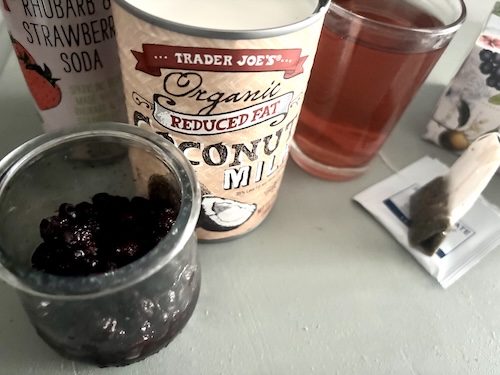
Dirty soda is made healthy with tea. What about a blueberry green tea like this one that that has strawberry and rhubarb flavors infused? Oh… and coconut cream (healthy fat) that dirties this beverage. This could be an elevated virgin drink you pour in a celebrational glass.

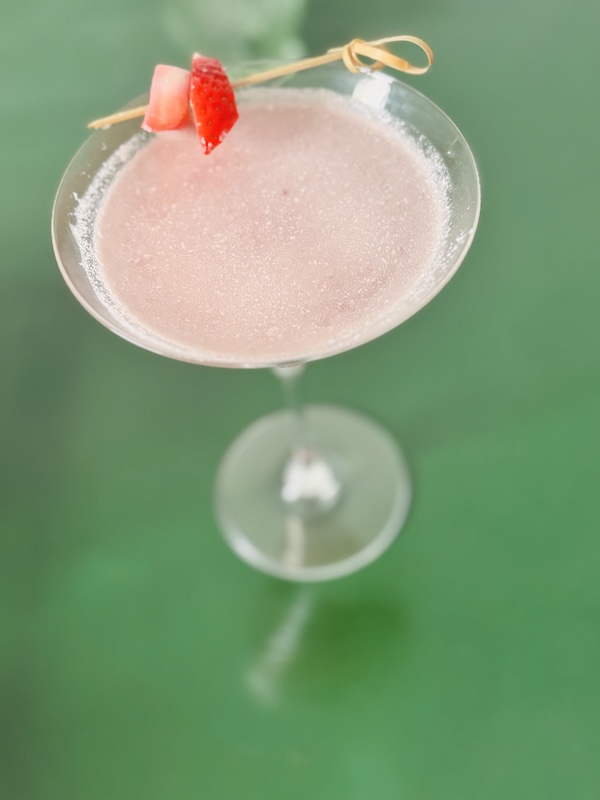
Dirty soda with blueberry tea, strawberry soda, and coconut cream.

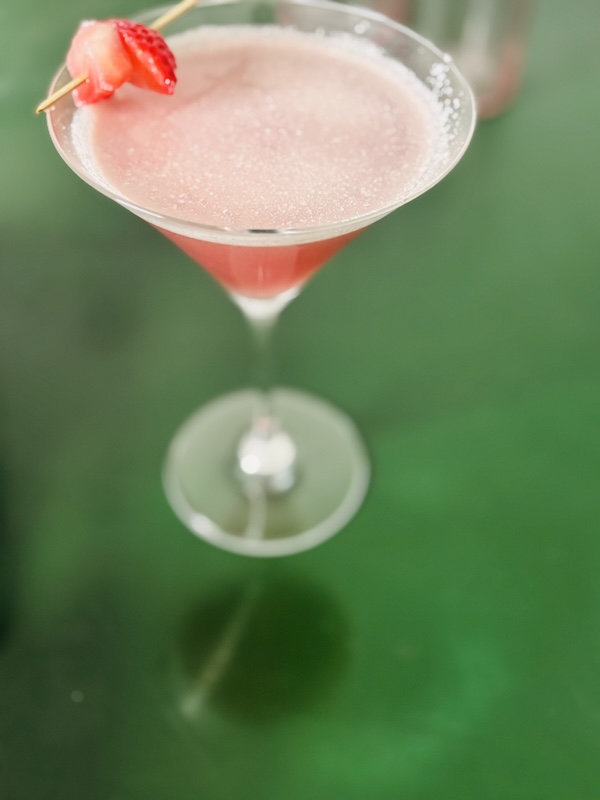
The pretty white is coconut cream that’s a healthy fat (MCT). If you’ve heard of MCTs, they help convert fat into energy and support metabolism.

They’re a natural energy boost that help you wean off energy drinks and old habits you no longer need… from cramming hard or finishing projects that tested you!

A cream soda is a good way to infuse new healthier habits, and one I dreamed up from a not-so-healthy, sugary cream soda can past.

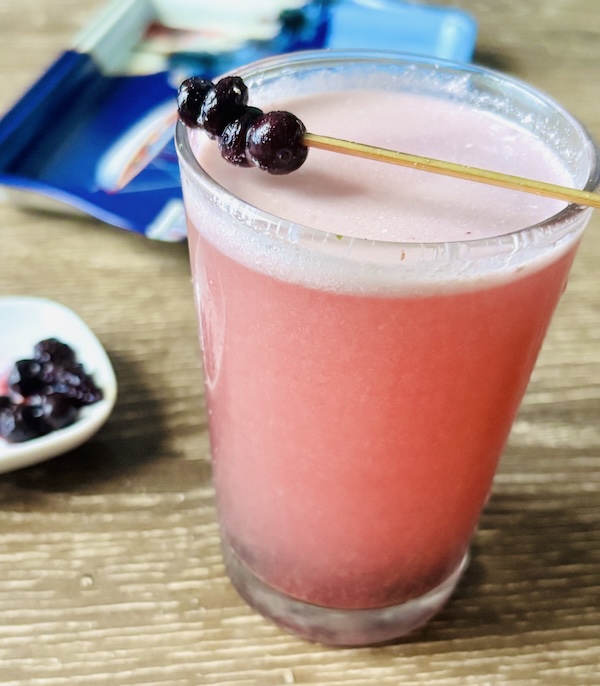
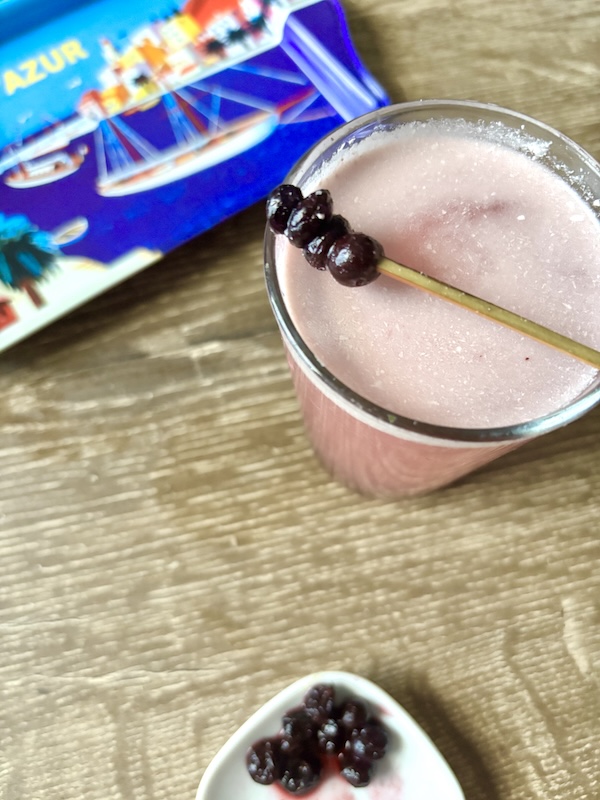
Dirty soda with blueberry tea and wild blueberries.

But with a splish dash of coconut (milk) and a splash of fizzy seltzer water, or gut healthy prebiotic or probiotic soda, is going to be better for you than regular sodas.

The difference between prebiotic or probiotic sodas, is feeding the good bacteria gut fiber (prebiotic) or adding more good bacteria (probiotic).

Both are good for you and your gut where most your happiness is.

…And a better healthy low-sugar habit. That’s good if you’re learning the ropes to calm your sugar cravings which btw helps overall healthy and weight.

And a good switch off artificial sweetened diet and regular sugary sodas if that’s your daily rhythm… I did that in my 20s when regular and diet can sodas were the rage (and still are today!).

They were complimentary in the office I worked in and gave me the daily energy push I needed.

…so I couldn’t say no (I thought).

And the healthy alternative was water. Still is.

But water as the drink of life lacks taste.

(Not to mention, it’s a tad boring compared to tea-fruit’s juice-soda variety. Where whole fruit is naturally an anti-inflammatory choice, and you can choose an anti-inflammatory tea).

So I gradually switched from breakfast can sodas to coffee for morning. And then tea in the afternoon.

Those were quiet options back then (without coffee shops everywhere other than diners and convenience stores).

Coffee wasn’t yet touted as healthy like it is today, and where easy home making coffee cold brew is my jam.

But over the years, coffee and tea helped me gradually wean off diet sodas.

…And if you want to be healthier too, a modern dirty soda is how you can make a micro-switch habit to add in more healthy drinking ingredients to your overall daily consumption habits, where the body keeps score.

These are the ingredients I used for my blueberry healthy dirty soda tastes:

…Oh, and like a healthy smoothie you make, you can’t go wrong with your mixology skills.

Like, you can’t add too much or too little. Because naturally, you’ll adjust the liquids because your taste buds (or someone else’s taste buds) will tell you so.

And if the fruity foods and beverages you add in appeal to you, they will be great in a mixed soda mocktail like this virgin dirty soda.

Dirty soda that's put in a elevated celebrational glass.

Whether you choose strawberry, raspberry, blueberry, cherry, or lemon flavors as your favorite now… or a vanilla tea instead of a blueberry twist one. Either way, is up to you! And it’s more than just a soda.

…And with drink in hand, you can let it help put a smile on your face to commemorate this season of your life. Or use tropical fruit flavors in season to remind you of a swoonworthy  summer holiday place to get out of wanderlust feelings that can strike at any moment of the day.

Tea dirty soda that's good for mental health reminders and green tea has theanine.

…Like a lower calorie Virgin Pina Colada (without heavy cream) can.

And if you’re wondering if you should strain the healthy fat from the cream soda, my two cents is don’t bother, as that’s what makes this drink “dirty” and fun.

Some like to make a bigger head (foam), that you can do with a frother tool like you would use for making home cappuccino foam.

And if you’d rather have your soda less cloudy, or more clear and clean, then you can add no-fat milk to your soda tea juice. It’s a good way to get Vitamin D and minerals into your day. And green tea has L-theanine that’s healthy good especially for longer term focus.

And a great way to get your wildly superfruit berries in!

Dirty soda with blueberry tea, strawberry soda, and coconut cream.
Print

Dirty Soda - Tea Drink

Course beverage
Cuisine American
Total Time 5 minutes
Author Brandy @ Healthy Happy Life Secrets

Ingredients

  • 4 Tbsp blueberry tea
  • 1 tsp blueberry juice
  • 2 Tbsp seltzer water or Trader Joe's soda
  • 1 tsp coconut cream, liquid portion
  • berries for garnish

Instructions

  • Pour ingredients into a drinking glass. Optional: shake ingredients in a blender if you like. To make an extra foamy top, warm milk of choice and then use a frother tool to agitate and thicken.

Sunrise Alarm Clock For Your Circadian Rhythm Health

Sunrise alarm clock is a natural body alarm that can help reset your circadian rhythm. Your best bet is to find a bedroom that has an eastern facing window with natural sunlight coming in. It’s that simple. 🌅

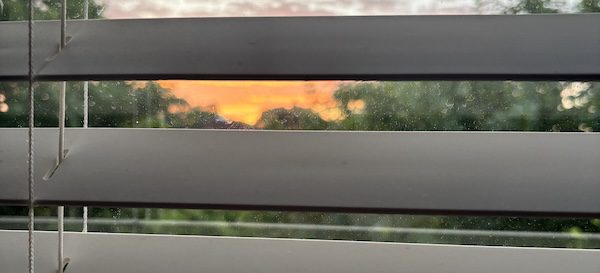
sunrise alarm clock window for circadian rhythm reset

But not always easy, as your room may not be located in that ideal spot. And to change that could mean having to move rooms or move houses entirely.

I’m not suggesting that you do, and I have a few recommendations below if you can’t get the bedroom sunrise view today.

Especially when colder weather rolls around and you don’t feel like getting up early. And a little morning glow could help… both outside and inside you!

Then with warmer weather when the clocks spring forward, it gets a little easier with a March pep in your step from more natural Vitamin D sunshine. That helps us become more daily active in our outdoor activities, gardening, or exercising

And getting outside more is a good start to get a healthy dose of absorbable Vitamin-D (the happy sunshine pill). 💊

Because happiness affects your energy (mood and having more energy) and vice versa.

This can help with getting more quality sleep.

…Where your sleep shouldn’t be completely season and weather dependent. It can be reset with your 24-hour internal clock (circadian rhythm).

And if circadian rhythm is affecting your happiness, then this is one of the first few changes you should aim to make.

Start with your local surroundings. Where do you spend most your time in the day? At night?

Earlier on in my years, I liked to sleep in and stay up late like a night owl. I used to be such a sleepy head. It took me a long time to wake up.🦉

These days, I think I’ve gotten in a better sleeping-waking up cycle because of natural circadian rhythm (another cycle) resets.

That (re)set comes from natural sunrise sunlight.

And is dependent on my bedroom situations (more than months or seasons).

…Where non-east facing bedroom windows encourage sleeping-in later.

I know this from my own experiences waking up in 5 different sunlight exposure environments within a recent 7-year time span. That was a good, eye-opening test.

…Where, in each bedroom, the windows had horizontal window blinds, but different window sizes. And some had more than one window.

But the biggest factor was the different sunlight exposures based on compass directions: north, south, east, or west.

I still find that tool fascinating. It used to be a separate device you could carry around like a compact mirror, and now it’s on some of our devices 🧭

It works whether there’s a window or not.

And the first place I was in had a windowless bedroom in the middle of the apartment. The bedroom had a pocket sliding door and outside that door is where some light naturally flowed in. I slept like a baby, but the dark light never promoted early mornings.

I always had a blaring alarm to wake me up then, and I never felt well-slept. I would have never considered counting on myself to get up or my natural body alarm clock to wake me up.

Waking up at sunrise would’ve been nearly impossible, and many hours away from the time I actually got up. That’s when I started drinking cups of coffee regularly for the first time in my adult life.

In the second place I moved to, the bedroom had northwestern exposure and more than one window. So it was neutral morning bright and I woke up at my then-regular 8 am or so time, in-time to arrive for a 9-5 job that was within a 5-minute commute.

Then in the third bedroom place, it was northeastern exposure and there was a very big square window like the kind you find in hotels. It was so bright in the morning with mirroring windows across the way, that I quickly added dark blue drapes. Because sleeping past sunrise would have been difficult without an eye mask or sunglasses. 🕶️

Those were tough remote working years in that city view, and I had no reason to get up at sunrise as my window was concrete view blocked.

Then in the fourth bedroom situation, the regular-sized window was full-on western exposure with the most beautiful purple and orange sunsets. It was a daily show. But no sunrise view anywhere I could see in any room.

…So there I found myself slipping into a pattern of sleeping-in later and later, as I went to sleep later and later.

And that brings me to today, where my bedroom is directly facing the east. The complete opposite to the previous situation where I always felt tired, even though I loved the sunsets and staying up late.

The flip was intentional. My last moves were not so intentional as I was not as choosy and didn’t realize the affects of sunlight and the circadian rhythm-sleep connection until I lived out my real life scenarios.

Today I naturally wake up to my body’s alarm clock thanks to my circadian rhythm reset.

With big window paned doors on the sunrise side and some shielding trees, I can fully look out at the morning sun. He-llo00 sunshine!

In this natural sunrise alarm clock lifestyle, I have the blinds slightly cracked open and they wake me up naturally. I don’t need an artificial alarm clock to wake me up.

I naturally wake up at sunrise but don’t get up until the 7 o’clock hour every day.

…That’s not sunrise alarm clock time, but much earlier than when I used to get up. And if I wanted to catch an eventful sunrise glow, I could and am well-rested. 🌄

Today is much more healthy, getting 7-8 quality hours of sleep per night. It’s no longer a guilt sentence to get adequate sleep. It’s a healthy move vs. being lazy.

It’s the opposite than when I started adult life.

We’re wiser now as sleep = longevity.

And if you’re not getting enough sleep, like less than 7 hours a night, you’re hurting your health that can show up in many ways.

…It’s not just about moods and cranky irritability. Less sleep can also add to weight gain and aging faster.

For young people, their brains are still developing, so they especially need more sleep. And adults can get more quality sleep with a few habits…

First thing, get sun in your eyes in the AM. This habit over days and weeks will help reset your natural circadian rhythm in your body.

sunrise circadian rhythm

Look at early morning light through a window when you take sips of your warm beverage. And wake up the same time every day no matter what time you go to sleep.

And if you’re like me that likes to look at devices or watch shows late at night, wear good blue blocking glasses. There are different quality glasses, so it pays to do some research as you only get one set of eyes.

…It’s a good habit to wear blocking glasses even for your smaller phones. It will make a big difference to your eyes and sleep health.

And lastly, if you don’t have eastern facing light in your bedroom, you can purchase and set blue lights or a sunrise alarm clock to turn on in the morning.

When I was younger, we had timers that would turn the regular artificial lights on when we were away.

The early bird still catches the warm. And you can get more done, exercise (that could be a new concept!) or read a little more of your book if you wake up a few minutes (or hours) earlier.

You may even surprise yourself as you inch your way closer to waking up at sunrise as your new alarm clock.

sunrise circadian rhythm
Print

Natural Sunrise Alarm Clock Habits

How to reset your circadian rhythm and wake up earlier or catch sunrise naturally.
Author Brandy @ Healthy Happy Life Secrets

Instructions

  • Face your bed beside eastern exposure windows.
  • Wake up same time daily.
  • Look out at the sun in the early AM with bare eyes.
  • Wear blue blocking glasses at night looking at devices.
  • Get outside more during the day for healthy sunshine-making Vitamin D (that helps regulate melatonin production).