Anti-inflammatory recipes help you practice daily meal prep and healthy eating habits, that pay off in your long run toward longevity. Below are recipe links from this blog to inspire your year, no matter what season you’re in. To your anti-inflammatory life! 🎉
Because an anti-inflammatory diet helps protect against inflammation in the body (skin, joints, teeth, vital organs) that are health warning signs.
And preventing inflammation flare-ups help protect against and prevent chronic diseases, such as cardiovascular diseases that are still among the highest causes of mortality.
Chronic inflammation is linked to tell-tale body signs that can also lead toward certain cancers and cognitive decline.
And type 2 diabetes (or lifestyle diabetes) is the one of the fastest growing diseases on our planet. No matter what genes you were bestowed, anti-inflammatory habits help fight against what’s stacked up against you in the environment that you don’t have control over.
Anti-inflammatory foods were and are a leading source of prevention, where anti-inflammatory spices are a big deal. Adding more spice in your life and to your diet helps support better health and longevity.
And sticking to an anti-inflammatory diet is also a remedy from following Diet Culture of some kind. It’s a long-term healthy eating strategy.
Where whole and minimally processed healthy food and ingredients in meals and bakes you eat are at the core of anti-inflammatory foods and your health eating. Anti-inflammatory foods are real (nutritious) foods that the body recognizes as healthy
And this includes plant-based foods, so eating plant-forward helps the body. And foods on a Mediterranean diet, which is a type of anti-inflammatory diet that includes healthy proteins and healthy fats, such as wild fishes and olive oil.
👉 Sign up to grab my FREE Anti-Inflammatory Diet Food Guide with printable food lists to help you make more healthy decisions for grocery food shopping. And get insights about an anti-inflammatory diet in the free guide.
And here on these pages of Anti-Inflammatory Lifestyle (Winter/Spring edition), you’ll discover simple and easy recipes you can make weekly. And get inspiration about anti-inflammatory living and seasonal foods you can lean into (that are more abundant and coins per ounce). To turn the pages forward/backward, click on the arrows at the lower corners of the pages. ↪
…Where, at home, you can make your own… no-butter bearnaise for a lower-calorie and anti-inflammatory-infused olive oil brunch sauce for a healthy Eggs Benedict savory dish… and you can pair with a low-fat sweet or low-sugar dessert recipe.
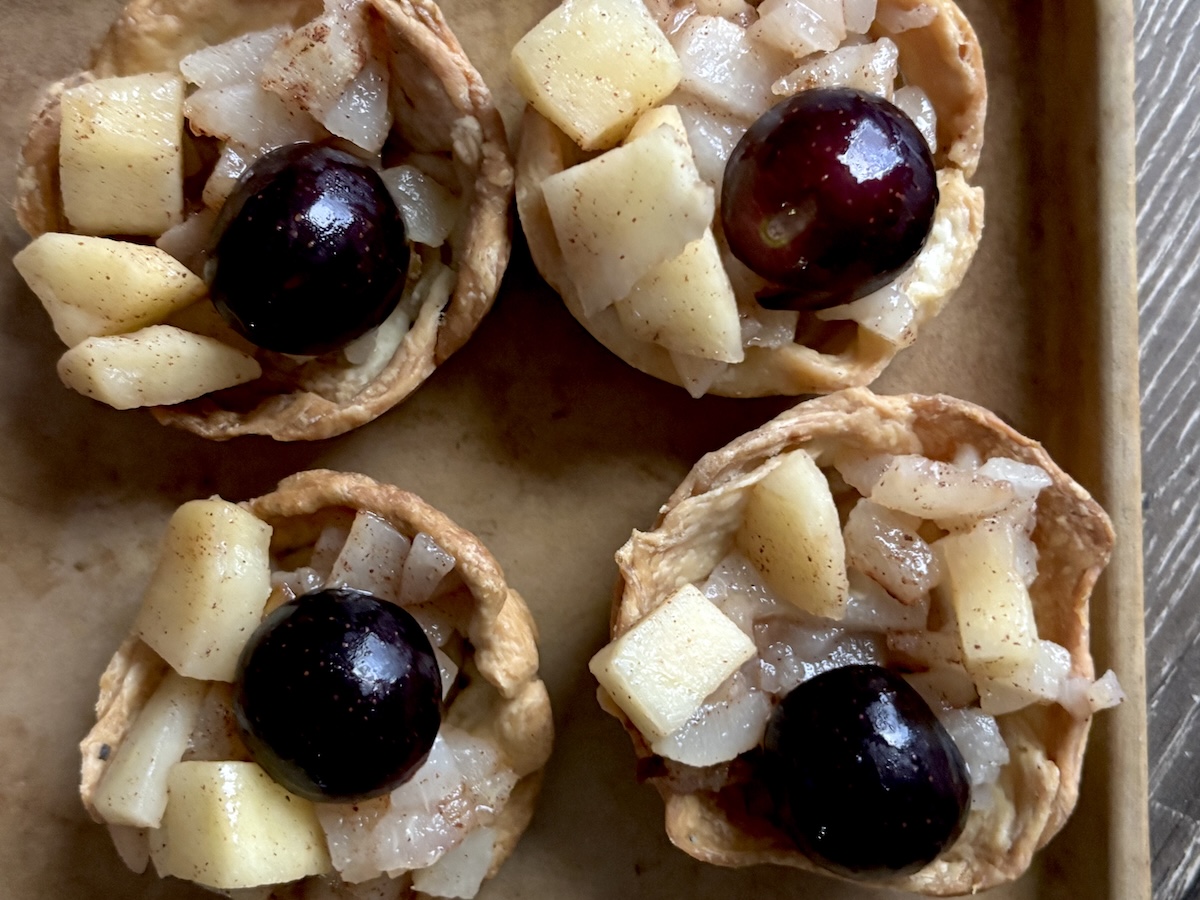
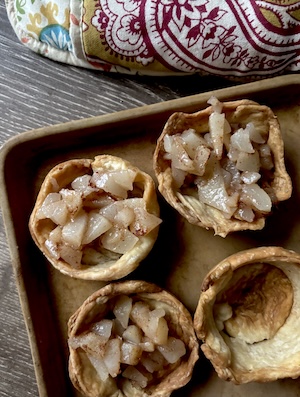
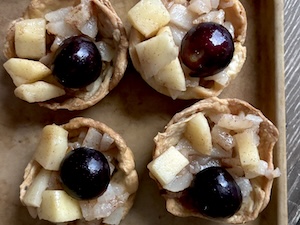
Pastry shell with an apple filling is a dessert that’s versatile and easy. And most importantly, delicious! As in a Red Delicious apple or similar fruit filling that’ll be delightful. These ones are decked out with Muscadine grapes, the in-season “cherry” choice on top.
These are shiny, but first you have to make the pastry.
And pastry is unique over cookie and cakes (that can made with healthy fats). But there’s no skipping butt-ah in pastry or else you have a paste.
…And you don’t need much for the effect. 🧈
The healthier truth is you only need a smidge ‘o butter to get buttery tastes. Think a knife pat vs. a whole stick.
..But-ah, it’s forgiving.
In return, pastry loves back.
You can’t mess up the pastry love (tastes) with its 2 ingredients… butter and flour. Sugar is not a necessary trio. And that makes this apple pastry a tasty low-sugar dessert. And an economical one.
…So it pays2-try pas-try!
And it’s also a lower calorie dessert option if you count water as a 3rd ingredient.
Water is often the most important ingredient in many recipes including this one.
Cold water is the kind that matters here for this easy dough make and bake.
And using a cold butter-flour-water trifecta makes it magical out of the heated oven.
Maybe that saves you?… where you don’t need to do a local bakery run in a pinch if ya got flour and butter in your kitchen.
And this recipe can be used or any rough puff pastry, from a whole pie to an individual pastry shell dessert pan.
Except one twist…
And this one’s a doozy in my book…
To make food life more interesting. And easy. It’s also always about the healthier but tasty ways in my shared world.
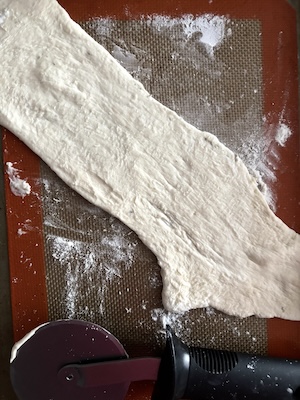
Tools like a pasta maker help do this.
That if you’re on the fence of whether you need one, if you like shortcuts (…who doesn’t?) this is a tool that helps you get thickness uniformity.
There’s a time and place for rustic, and it you want a consistent thickness roll that works for pastry, a roller will do that and help with the crisp finish.
With a roller, it’s still by hand because you’re cranking the machine handle. But the dough won’t bounce back like it often does with a hand roller.
A pasta machine is more like a press or iron.
And you can roll a few times after each fold that will create some well-worth-it lamination and flakey crunch texture at the end. You’ll be glad you did. And for fun if nothing else! 🎉
That makes bringing out the equipment worthwhile.
Which btw, a pasta maker comes in handy during holiday cookie season. You can even make cookies this way to get even 1/4″ cookie dough.
And then turnaround and make homemade pasta from the same machine.
This is the pastry shell bottom with the recipe below:
To construct the sealed pastry shell bottom, instead of one flat round piece of pastry dough, I cut out a round piece with a round cookie cutter on the bottom and attach to long pastry strips that become the sides.
This way you get more of a deep basket to hold more apple filling (making it healthier). Like a wicker basket effect. 🧺
But you do you!
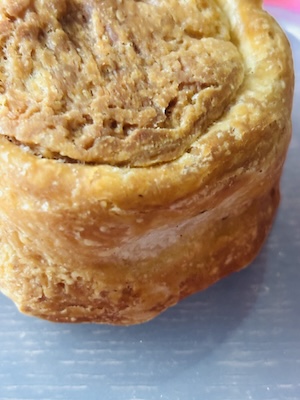
This yields delightful pastry tastes and textures I can only compare to Palmiers if you know those (like my younger self did 🧒🏻)… they’re a little crispy and very buttery (even with the little pat of butter)
To make the apple filling: you can rough chop apples, and add in an oven-safe bowl or skillet with a little water, and bake alongside the pastry. No need to heat separately.
Be sure to add water so the apples don’t dry out. I love to add cinnamon and it leaves the nicest oven potpourri aroma. Baking and heat invigorates the spice.
When the apples are soft, you can bring ’em out of the oven while you check on your pastry.
This comforting autumn bake can be a warming autumn ritual, that pairs with a steaming hot mug drink you sip on.
It’s comfort food. And maybe you just had a comforting potato soup bowl (that’s low-sodium).
If you want to freeze the baked pastry shell, they will be just as good.
Let them de-thaw overnight in the fridge and they’re as good as new for the next day.
And just in time for apple season!
How ’bout them apples? If you like this apple pastry shell recipe idea, you might also love an apple cheesecake. 🍎
This makes 4 regular (2-3") muffin diameter-size pastry shells.
Course Dessert
Cuisine American
Author Brandy @ Healthy Happy Life Secrets
Equipment
pasta maker or baking roller
cookie cutters
muffin or cupcake tin
Ingredients
1cupflour, plus bench flour
2-3Tbspbutter, cold
3/4cupcold water
Instructions
Add flour to a bowl. Cut off small bits of cold butter (from the fridge) and add to the bowl. Add enough cold water to create a soft shaggy dough disc. If too wet, add some bench flour to the dough disc top and bottom.
Cover the dough and let chill for about 10-15 minutes in the fridge (or freezer), or overnight in the fridge.
Add bench flour on the outside of the dough so it doesn't stick to your fingers and pasta maker or dough roller.
Fold the dough a few times to create lamination that will help the flakey crunch at the end.
Roll dough at least twice after folding dough. If using a pasta maker, use higher settings. On my pasta maker, it's "7" for about 1/4" thick rolled dough.
Butter or baking spray the bottom of a muffin tin for non-stick. With the rolled dough, cut out 4 round bottoms with cookie cutter. Add one to each muffin pan cavity bottom. With the remaining dough, cut approximately four 1" long strips and wrap around as a ring for each cavity to make a basket shell, patching together with the round dough piece.
Bake at 375°F/190℃ for about 35 minutes until dark golden bottoms.
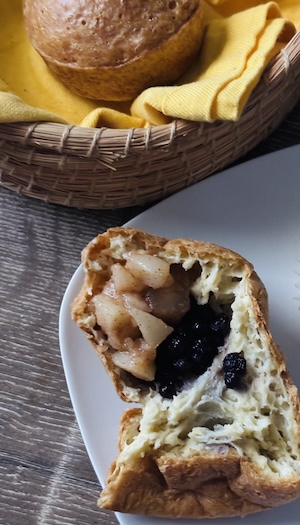
Popover is a sweet one you can fill with your favorite fillings like a pudding, custard, or jam that goes great with warm tea. Like this one straight out of the warm oven. The nice steam is blurring the lens.
This is not a bread …and actually a popover is usually described as pudding or custard and an egg based batter. But I like to compare it as easier than making choux and bread, with just 3 ingredients (and no need to knead).
With easy 5 minute prep and 30 minutes of bake time, you’re done in the time it takes for easy pastry. All my notes below.
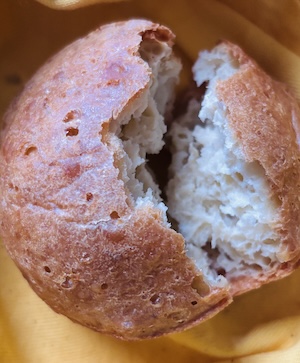
And however you describe a popover, it’s hard to beat a sweet bake like this one here that looks like a choux pastry inside and a muffin on the outside. It’s a versatile bite great for any brunch table, dessert occasion, or sweet craving.
And one you can easily do, like as easy as making pancake batter.
A popover is especially magical in the oven because it does not need any leaveners like baking powder or baking soda, like in a cake or muffin recipe that is more dense.
The oven does all the heavy lifting rise when you do all the steps (and you will know what those are from below).
Then with the all the flavor options, you have a versatile popover dessert you can fill with so many sweet (and healthy) options… so, it’s a tasty crowd pleaser.
And like muffins, they’re better fresh and home baked than store bought. I remember my first muffin was a muffin made from a box. The fun part was draining and adding to the batter, the small can of blueberries that came in the box.
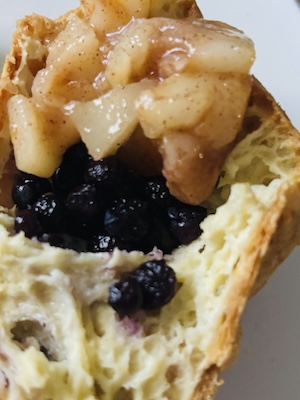
Kinda like these blueberries sitting in this popover with cinnamon pears. Sounds a little like a (papasan) chair for fruited desserts. 😋
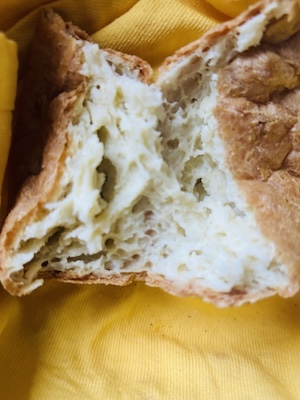
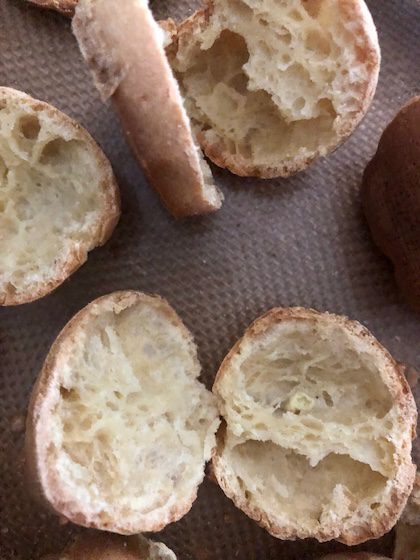
And a popover, when opened inside, is lighter than a muffin or cupcake. Like this one that sat in one of those tins…
Inside a popover, is a light and airy baked bite. One that can be no-butter or a pastry substitute.
Because NO butter can be a dilemma in your kitchen when you run out and don’t wanna run out (to get more). And in that case, a choux dessert is easily ruled out.
…And then you’re faced with your cooking oil options in your kitchen.
If you’re not up for baking a cake, you have less easy sweet options. Maybe pancakes or brownies?
…Sometimes, meh… those can get boring (like my muffins from a box 😊)… and maybe saved for another day.
So then I got you!
Because a popover saves the dessert day.
You can use the oil you have for priming the baking pan.
…Or if you do have a little bit ‘o butter, you can use it to coat your muffin pan bottom… and the benefit is the buttery flavors will actually infuse into the muffin for a buttery popover taste.
Your oven will also have a buttery aroma that’s pleasing to most. And again there’s no butter in the batter itself.
But butter is a sensory pop-over-load that you can lean into when your popover is popping over in your oven.
All you do is make a simple popover pour-over liquid batter (like a pancake batter)!
Let the batter chill and then bake in the oven for 30 minutes until golden brown.
And on the other side of the oven, if you open a popover when it’s still popover warm or piping-hot out of the oven, you’ll let out the steam (and experience a mini steam facial).
This makes a popover uniquely different from a pancake.
And what it most resembles is a choux (not a shoe 👠) that’s a pastry. A popover can’t fill those choux.
Popover vs. Choux
Inside a choux you’d delightfully notice has a light and hollow interior.
choux inside.
And so does a popover.
But unlike choux, you don’t need to guess at the number of eggs based on the baking day and rely on your intuition. Which, btw, eyeballing to me is usually more reliable.
But with a popover, you don’t need to do either. You can just use the recipe and easy to remember 3-ingredient proportions to make as many popovers as you want, in any shape you can make and dream up. 💭
Oh, and choux has another distinct disadvantage of relying on butter for it to work (or else you can end up with a pancake batter or pasta dough 😊).
And choux is usually using both the oven and heated stove elements. With a popover, you need only use your warm oven.
That makes it easier… and more energy cost-saving at that!
So with all those reasons, ready to pop over to your kitchen and make your dessert that’s easier than a Dutch baby?
Whisk eggs by hand to incorporate into a liquid in a bowl. Combine in flour and milk and refrigerate overnight (or chill in the freezer for about 10 minutes before using). This is a liquid batter.
Coat the bottom of your muffin pan.
Pour the liquid batter into the muffin pan, about half full for uniform muffins. Or if you want more of a rustic look, where the muffins have different large muffin tops like a wild mushroom, then fill a little more to the top.
Bake at 350°F for about 15 minutes, then turn the oven to 375°F and bake for another 15 minutes until the top is golden to deep browned. You can create a sheen on top with milk or egg wash if you like.
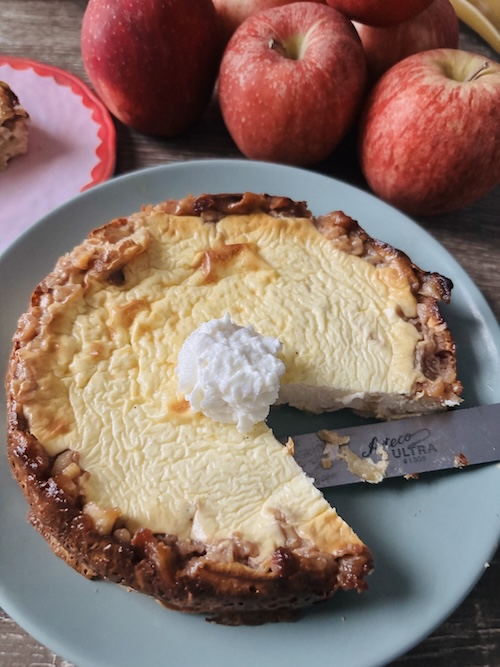
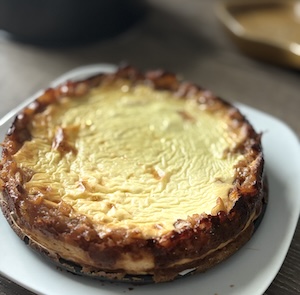
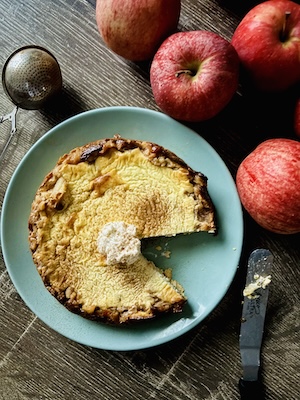
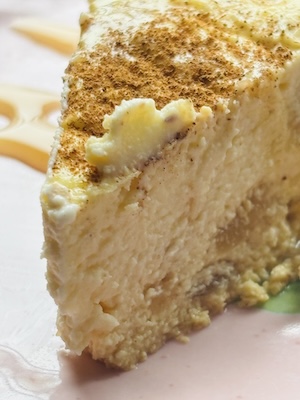
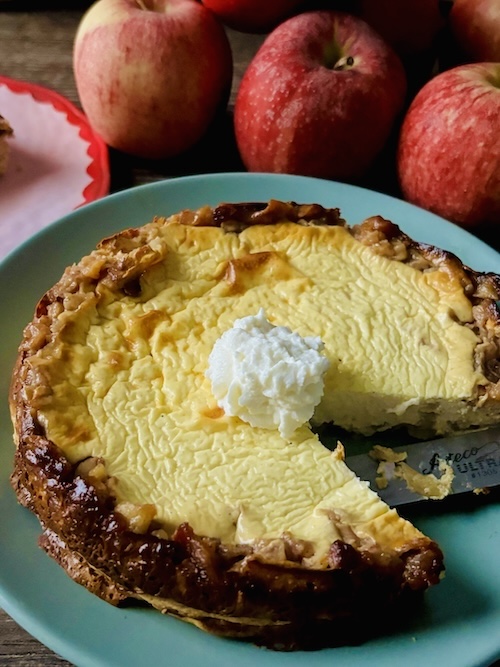
Apple cheesecake is a happy dessert. And can be made low-sugar, but apple delicious. You don’t have to add any sugar with spice if you choose.
…But I love a heavy handed douse of cinnamon and fall-ish nutmeg spice.
Why not?, I say.
To make the apple cheesecake: separate 2 eggs. And break up the 2 egg yolks in a bowl where the cheesecake batter will be made.
You can save the egg whites for meringues or your egg white breakfast bowl or a no-bake apple meringue dessert.
In batter bowl, add in 1 cup ricotta cheese and 1 cup thick Greek yogurt. Set aside.
Btw, thick yogurt doesn’t always have to mean whole milk. I used a nonfat Greek yogurt this time, and unlike the myth, did not have more sugar to compensate. You don’t know until you read the ingredient label.
But what you do know is if you use a thinner (more liquid) yogurt, the bake will take longer to bake, and the cheesecake will not fully set and may not stand on its own without sides. But the cheesecake tastes will be there.
So your best is you can practice test, and then keep note for sourcing next grocery shopping time.
…Because you’ll want to make this again! 💕
Apple cheesecake is one apple-y great fall cake when apples are abundant AND when you’re trying to figure out what to do with all them apples!
The apples can fall off the trees and into your bakes. And then melt in your mouth.
An apple cheesecake is also great year-round when there’s no apple picking… but there is a holiday and celebrating. And you have a few apples around.
Apples pair so snugly with cinnamon spice. Eaten, it sweetens and calms at the same time.
You can add the spice(s) at the start into your apple mixture.
The mixture is easy to make from scratch. It’s like making a compote, that will turn into a soft apple chunky sauce texture.
In a cake, fresh apples is a better deal as you can get small taste bits of sweet apple in your bites (like in an apple pie 🥧).
…when it’s said and all done.
But first you have to prepare the apples! And you start prep by de-skinning your apples and removing the cores.
Then rough chop the apples and add to a dark skillet. You can soften them on the stovetop or in the oven. I make it an easy choice. I simply choose to do it in the oven when it’s baking day.
I add the apples in the skillet with a 1/4 cup of seasonal apple cider (or you could use water).
And you can even add orange juice to give an ambrosia sweet taste harmony effect in your mouth. 😋 Up to you!
Then put in the oven while it’s preheating at 350°F for the cheesecake bake.
Before heating, add your spices to the skillet, so they meld and activate in the heat.
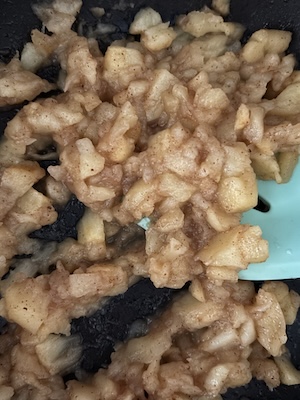
Let the apples heat soften for about 15-20 minutes (in the oven or stovetop) until you can easily use a spatula to break up and smash them down a little. But not too much. You don’t want jam or applesauce.
This looks about right…
Let the apple mixture cool a little and slowly add to your now apple cheesecake batter. You can also reserve some apples for cake decorating.
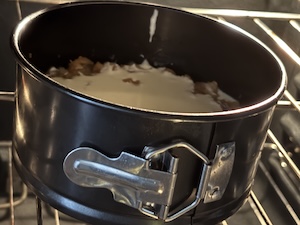
Then spoon-pour the liquid batter to your sprayed, oiled, or buttered springform pan. I like to add a piece of baking parchment paper as bottom insurance, that you can peel off at the end. You do you, but whatever you do here… don’t skip this sticky step, and especially if you use a regular cake pan.
If you saved some softened apples, you can even leave an apple trail pattern on the top sides if you like to decorate your ricotta cheesecake, and your efforts will show up after baked on the cake…
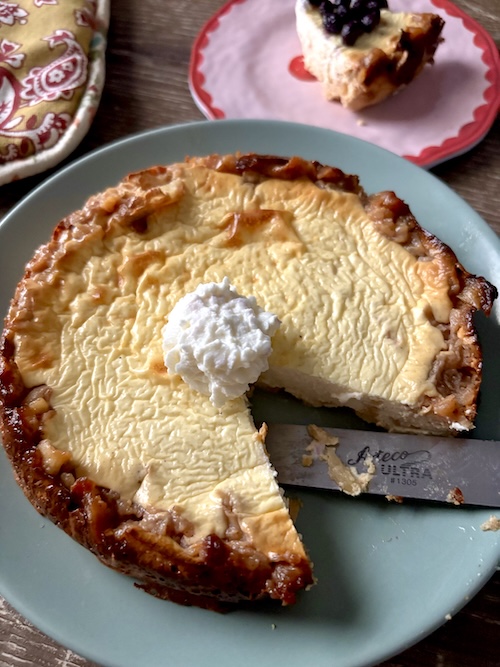
And it’s as good as it looks! Apple pomes works so well with a zing taste of ricotta in a cheesecake, that’s like lemon tartness without the summery vibes. 🍎
And you can dollop ricotta at the baked end as the whipped cream. Dollops remind me of doilies on a worthy dessert plate or warm dessert beverage.
For baking instructions: Bake until the top sides are golden brown and a toothpick comes out clean.
Your oven will have cozy apple aromas.
This one took 1 hour and 15 minutes in a 350°F oven on the bottom oven shelf. And that’s about how long it will probably take in your oven.
I exercised self-control and left the cheesecake in the oven for a little longer after the oven was turned off. That pays off because, fully set you could actually pick up the cake with your fingers and it shouldn’t fall apart.
With dessert on a plate, you can decide if you want to add warm douses of cinnamon dusting or serve with berries.
Or to each her own. I added a honey drizzle to my bite.
Want more easy apple recipe ideas? Try the ones above and an easy apple galette.
This is one apple dessert that's texture and flavors you'll love. This is for a smaller 6" springform pan.
Course Dessert
Cuisine American
Author Brandy @ Healthy Happy Life Secrets
Equipment
springform pan
Ingredients
2-3chopped apples, cored and de-skinned
1/4cupapple cider (or water)
1cupGreek yogurt or thicker yogurt
1cup ricotta cheese
2eggyolks
1Tbspcinnamon spice
1tspnutmeg spice
Instructions
Make the cheesecake batter: Break up the egg yolks. Combine in the yogurt and ricotta.
Make the apple mixture with spices: heat for 15-20 minutes in oven until soft. Mash into a compote sauce consistency. Let cool and then add to cheesecake batter.
Prepare the bottom and sides of a springform pan with oil, butter, or baking spray.. Add a piece of baking parchment paper to the bottom.
Pour batter into pan and bake at 350°F/180°C until sides are slightly golden brown and a toothpick comes out clean. The time could vary based on the thick (height) of your batter and how much (yogurt) liquid you add, about one hour.
Baking substitutes come in handy when running low on ingredients or when you don’t want to run out to the store.
Example: you can make your own milk at home with oats or almonds.
You can also substitute eggs and butter with other healthy pantry ingredients, when you know how much and when to add.
You can even substitute regular flour from the all purpose type to an on-healthy purpose kind. Maybe even gluten-free.
Then after some practice, you know better what you’re doing.
Because like everyone starting off, I didn’t know what I was doing … I built a kitchen food pantry that was healthy-ish coming off of 2020 difficult times, where sourcing groceries was online (not up close and personal).
I bought healthy foods and some not-so-healthy ones based on screen availability, where the healthy-ish-part cancelled the healthy.
Like sugar products, that when eaten in heaps puts your body on a roller coaster. 🎢
…And as a metaphor, how decades ago, I used to live in that unaware (half-conscious) way.
…When my thoughts were happy, I was in a good mood.
Many don’t know how to live a different way.
It’s easy to enjoy life when happy thoughts are co-created from the heart.
…But many days, if you were to count on a calendar, don’t start off that way.
And there’s a better way of not counting on your natural thoughts and feelings.
…So from that, I built better habits in my life.
I then later learned the way to speed up happy thoughts when the mind doesn’t want to cooperate.
Coffee first thing, definitely helps with that mission. ☕️ I’d be amiss if I didn’t mention that cold brew makes it possible for a soft landing.
And then I pair with foods like prebiotic carrots or bananas.
Happy foods they are feeding the gut (where most the happy hormones are made).
Healthy foods can taste happy for you too when you look at them as doing good for you, like I do.
…And if you know how to pair them and prepare them for delicious meals.
And so as the years passed, happy-healthy foods then became my mantra as I weaned off having to have bags of sugar… or cookies around.
Today those are an occasional treat, but no longer a crutch or an emergency sugar lifeline, as I can make my own version.
A few pantry items I always have on hand are: oats, extra virgin olive oil, coconut oil, spices, honey, and applesauce.
Some of these ingredient types haven’t changed from my original pantry. They’ve stood the test of time.
Tried and true, the more wholesome ingredients aren’t boring when they are the way to a delicious recipe full of taste variety.
Like adding in abundant seasonal ingredients.
…Fruits come first to a more abundant mind.
And fruits help a healthy body.
They’re also happy fuel for daily thoughts. They can be game changers when you appreciate them.
They’re also easy to get. You don’t need the stars to align for happiness sourced via fruit.
Often you don’t even need permission for that type of happy. As a kid, we could grab low-hanging fruit at our little hands’ reach.
Today you can grow a fruit tree from a seed.
The fruits can be enjoyed whole or in a fruitful jammy recipe.
And for me, baking is my jam.
So I also keep a variety of flours available for healthier baking substitutes.
Most of my favorite experimental baking recipes use healthy baking substitutes. I created a dedicated section on my blog’s home page for healthy ingredient substitutes.
This go-to section is good when you want to try healthier recipes and get inspired by food and baking substitutes that work, without inventing the wheel.
Especially if you want to change to healthier eating ways and habits without giving up tastes, one easy recipe at a time time. They’re often quicker bakes… and some are even no-bakes. Or slow bakes if you want.
Along with recipes, inspiration for the oven comes from the ingredients and foods you’re surrounded by.
Plus food and baking shows…
It’s Game Day season, but it’s also Bake Day season.
Not any ‘ol baking season, but cheeky Great British Bake Off season is upon us.
…Or BE-AKE time!
That once upon-a-time was known as The Great British Baking Show on my side of the pond.
…Or what I call The Great British Bakeoff because I love the show. You too?
And whatever you refer to this baking season or television show as, you always want to have a dessert ready in hand when screen sweet tempted.
Baking substitutes are mainly the unusual flavor choices. And this season, change in the sugar and salt (judges).
I’ll be eating it up laughing, learning along, and baking with the new season.
GBBO time of year marks the start of fall and holiday baking season when the oven gets cranking, so it’s a good time for you at home also to bake!
And on my side of the set, I put a healthy bake game plan together that maybe are your desires too.
A healthy sweet substitute can be as satisfying and happy guilt-free. You can have your cake and eat it too!
And it can be easy. Where baking at home this season can be relaxing and rewarding.😋
Because it doesn’t have to be hard or sugar-full in your home. You can get away with no granulated sugar bags in your home.
Something I used to love.
But now I love shortcuts. And tastes that aren’t about the sugar.
…Like easy rough puff pastry that can be even tastier than shortbread.
And you do it once, and you may not even need a recipe the next time…
Let that be some inspiration!
And that can be your micro-technical baking challenge in your tent.
But under no-pressure bubble like in the white tent.
Not like this season’s GBBO technical situation… where it just go tougher.
…Whaaat, NO recipe!?
They just get an illustration like we all see on our home sets. Oh my!
The brave contestants have to make it come to life for the real life judges.
That’s no easy feat for the gingham table in the tent. 🎪
Where on bake day, we’re happy and they’re sad. Or mellow.
And we can cheer and celebrate them on…
We can sympathize and challenge ourselves to a new recipe.
…Not with a yellow cake box that has pictured ingredients. But something new.
That can open the door to a new way of baking.
Maybe a healthier way and habit that comes just in time for new years’ opening. That’s what I did way back when.
And now maybe it’s your turn?…
Ok and now that you’re food prepped, it would be cruel for me not to arm you with a bake challenge:
Here’s one: a fruit cake with coconut flour. And if you don’t like chocolate or coconut, try a vanilla cookie with no butter that may look swirl botched, but will leave ya chuffed. 😋
These are some more healthy bake challenges if you get bored. I change them from time to time to keep you on your baking toes. 🩰
Amaranth vs quinoa is a good comparison for grains. They’re both actually pseudo cereal grains (seeds), and not from rice, corn, or wheat.
They’re both complete proteins, meaning they have all essential amino acids.
So they’re perfect breakfast starters to get you going on a fuller meal.
…Oh, and gluten-free.
…Someone’s ears just perked up.
Because if you’re trying to eat less gluten (or are allergic), amaranth and quinoa are more on filling you with protein. And filled with vitamin and mineral nutrients.
Quinoa for starters, is a popular whole grain.
I remember the 90s Friends episode where the trend took off. Move over rice and couscous in the pantry, quinoa became the household food newcomer.
As the world sped up from old fashioned times, people wanted quicker meals.
And quinoa fit the quick and easy to cook up profile, vs. other grains like some raw rices take much longer to cook and soften.
Today, decades later, you can add amaranth to the list as easier to source and quicker cook-soften.
It’s an ancient grain and known as a longevity booster to help your longer ancient-ability.
Farro, einkorn, and spelt are also ancient, but they’re wheats, so they have gluten.
Then there’s barley as its own grass category, like wheat.
But if you’re looking for gluten-free, try the pseudo-cereals like quinoa, amaranths and buckwheat.
Buckwheat is usually ground into a flour. You can bake into desserts and sweets like a buckwheat ginger cookie. You may have heard of them in soba noodles.
So now that we’ve cleared that up, we know different grains for a savory bowl cook differently.
And smaller pseudocereals cook quicker in 20 minute or less meals, with amaranth vs quinoa being the more practical choices.
So which is better?
Of course, that depends on you!
…I really like amaranth because it won’t burn-stick to your pan like quinoa if you’re deciding on amaranth vs. quinoa.
Amaranth is mushy with water and quinoa is more dry, so it can burn more easily if there’s not enough water in your pan at any heating moment.
With amaranth in water, you won’t lose a single grain as it can become a mushy ball and soft like creamed wheat, or a porridge you can spread out in your bowl.
Quinoa is usually more dry like fluffy wild rice that I like to compare it to as each piece stands on its own. Each piece looks like a small piece of thread hanging on each quinoa seed.
And because of these texture differences of amaranth vs. quinoa, cooked in liquid amaranth doesn’t linger in your mouth and end up on your teeth after you’ve finished your meal.
But don’t let that stop you from you quinoa.
Because as for healthy notes, both are still great protein options.
If you’re needing fiber and lower glycemic index options, quinoa is a better choice.
Amaranth is higher in calcium and minerals. Also, if you are looking for easy to digest foods like a temporary BRAT diet, amaranth is a great variety option to keep in your pantry.
You can also add a little amaranth to bread dough (like you would sourdough starter) in a healthy whole grain roll.
And the best part is the versatility of amaranth vs quinoa that you can mix up in your meals.
Amaranth can also be made more dry (instead of the mushy texture already mentioned), as you can make “popping” amaranth like stove popcorn.
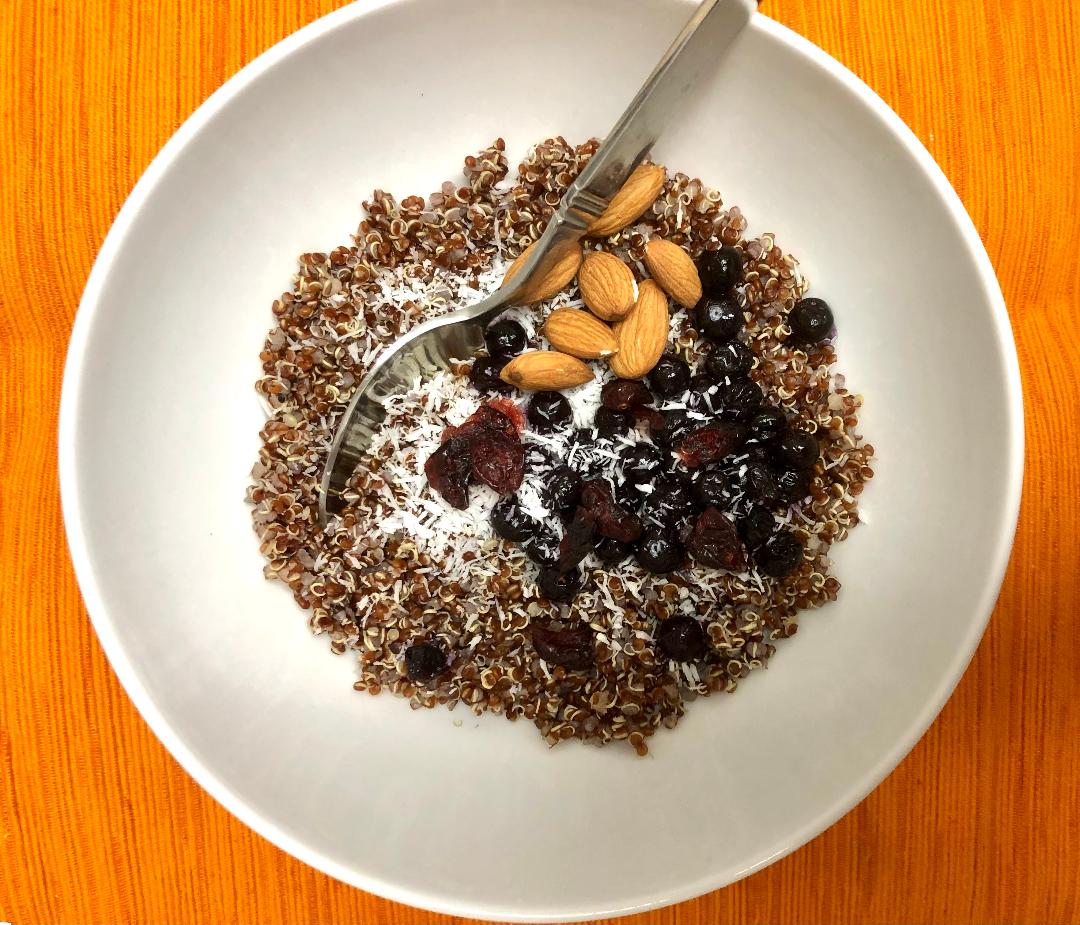
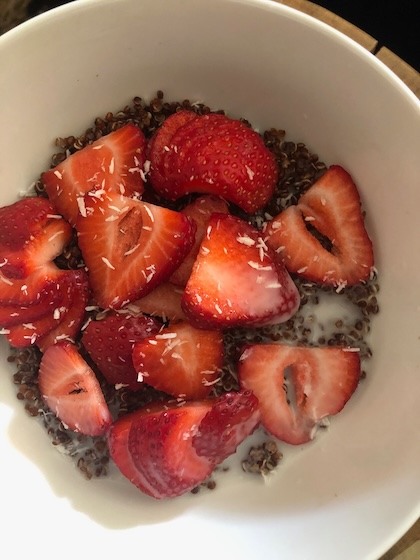
Or you make quinoa more wet in a bowl, like in a quinoa cereal with your milk of choice. This is good for Vata balancing as your body is feeling dry and looking for more moisture that you can get through a healthy bowl.
Add in your nuts and seeds. Oh, and how about a heart healthy quinoa bowl to start your day?