Butternut squash is a low histamine food that’s good for seasonal allergies.
Food does make a difference and you can mix in your veggies and lean into more squash with spaghetti squash.
Often we ignore some produce foods in the grocery store, heading for the ones with marketing words and labels.
But the best seasonal foods (like butternut squash) and those for seasonal allergies don’t have ingredient labels. They don’t need them.
And they contain vitamins and minerals, and healthy food body benefits that are contained inside the food.
The PLU, color, and skin often give away what that can be.
But then there are other food benefits like low histamine that is underrated for seasonal allergies.
If seasonal allergies has got you, you’re in good company and I have a list of natural above-the-neck soothing tips below…
Before 2015, I never felt outdoor seasonal allergies living on the east coast. Now, they linger around year-round and I’ve learned to manage them… and maybe you manage yours.
Tree pollen (e.g maple, juniper, elm, oak, etc.) found in most U.S. areas is the main culprit for spring seasonal allergies that starts as early as February these days.
Allergies are your body’s annoying, but healthy response to your immune system working. 🌱
Reducing histamine can be the difference of low congestion, itching, aches, and digestive issues.
Sneezing is the body’s natural way to rid of allergens in the body, but some congestion days that doesn’t always work.
If that’s you, you can keep a black pepper tin nearby and peppermint essential oils are good to sniff and use in your steaming shower.
You have a choice to stay indoors for high allergy days which is really the most effective way to dodge seasonal allergies. Try to do your outdoor walks earlier in the day. I know that’s still a bummer. So another idea is you can jump or stay in the pool. You may be able to pull it off like this unicorn making the most of it! 🦄
And when you’re indoors, stay further away from the open window if you’re super sensitive or keep the blinds semi-shielding.
These are 10 Tips For Seasonal Allergies:
✅ Change your clothing and take a shower as soon as you can or remember to. The steam will help you feel better faster. A night shower will help especially if your seasonal allergies feel worse in the afternoon or evening.
✅ Weekly, use a neti-pot to clean out nasal passages. This helps you get some relief naturally and prevents nasty sinus infections and your taking unnecessary antibiotics. That’s probably the best tip I can give you! Water is your friend away from pollen.
✅ Also, use a natural saline nasal spray to clear your nose as needed e.g. 2-3x per day for relief. Look for grapefruit seed extract with microbial properties that help prevent bacterial, viral, and fungal infections.
✅ Use a free-standing daily air filter machine with a HEPA filter for pollen (not just dust). Pollen kicks up in the afternoon and evening so it’s good to have the machine cranked up while you’re sleeping.
Change your house air filters as needed and vacuum the filters regularly as they will work better dust-free.
✅Use a desk humidifier or have one set in each room. Moisture like this works especially well during spring allergy season.
✅ Keep eucalyptus or mint oil essential oil drops close at hand. They work well in the steamy shower. You can put a few drops in a small vessel of water and sniff. Unlike a nasal spray, the oil drops don’t enter directly into your nose.
✅ For foods, add fresh horseradish or spicy wasabi that’s great for clearing nasal passages. Also increasing Vitamin C and bromelain helps. Pineapples are a good source.
Disappointingly, local honey doesn’t work the way that maybe you hoped it would for seasonal allergies.
Honey comes from flowers, and tree pollen comes from trees so there’s no cross-pollination… or an ex-pollinating effect that would be helpful for spring seasonal allergies.
But raw honey is a good natural sugar substitute and a natural humectant that when topically used on the skin help prevent dryness and other light skin inflammations or itches.
Honey also has other “anti” properties that are good for you… antioxidant, anti-bacterial, and anti-fungal.
✅ Keep up your vitamins and minerals, especially Vit C, D-3, Calcium, Zinc, etc. Butternut squash is loaded with Vitamin C and A. And a tropical fruit smoothie is a great way to help soothe seasonal allergy symptoms.
✅ Drink teas. You can try a good green matcha tea or black tea (Vata preference) early in the day and then switch to decaf/herbal teas in the afternoon. You can do decaf all day if you prefer.
✅ Keep eye drops close by for dry eyes. You can wear blue-light-blocking glasses, so you don’t have to strain on devices that worsen dry eyes (and they help you sleep better).
✅ Keep cough drops nearby, in case you get a dry or itch in your throat. And menthol cough drops help to open up passages.
Seasonal allergies don’t have to be the daily annoyance that runs your life. You can have a much smoother season if you stay informed.
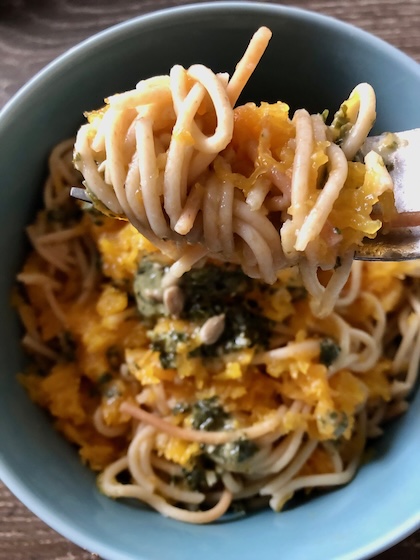
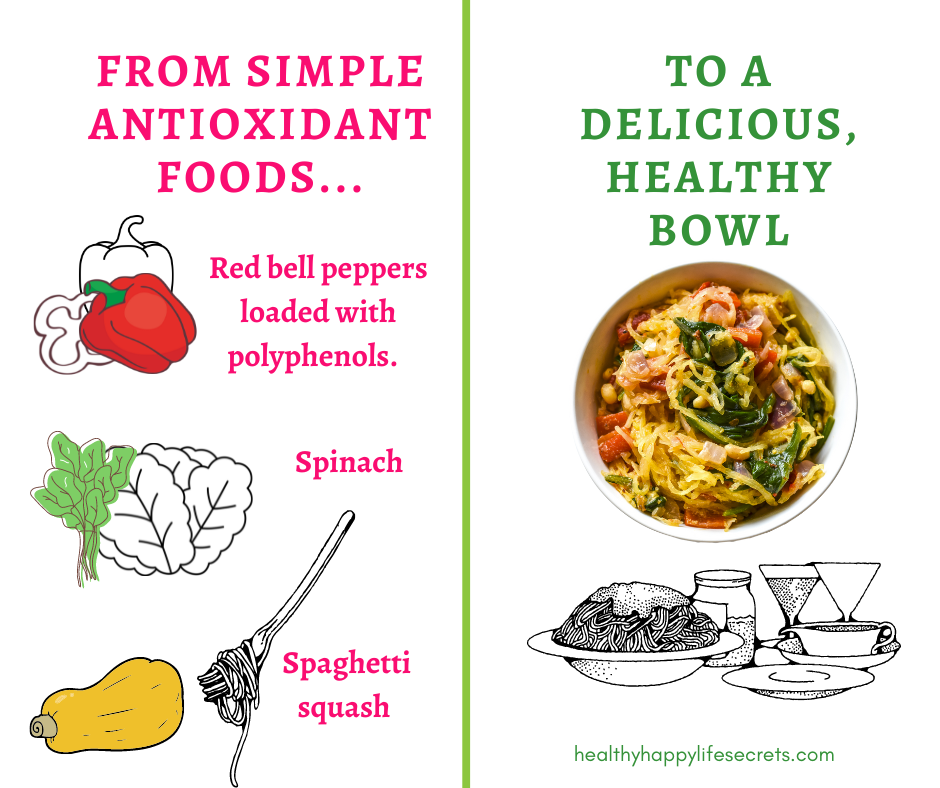
✅ And finally, bring in more healthy anti-histamine foods such as bell peppers, squashes, and eggs. You can incorporate a butternut squash spaghetti recipe that you can blend with regular egg pasta or spaghetti squash. 🍝
Wild Thing Pose is one of the most interesting name yoga poses. And it’s a beautiful pose like this wild natural artwork up the side of a bridge.
Sometimes you just need to let your hair down. So today I’m sharing two yoga poses that let you do just that, and maybe give you a few minutes of creative joy if you haven’t felt that in a while. One is called Wild Thing pose.
You may know the pose (or vintage song titles 📼 with the same name). The Wild Thing pose helps unleash your creativity, especially if you feel like you’re in a rut or ready to pivot. This pose can help you feel a little happier.
…On Fridays especially, don’t you feel like a little weight has been lifted off your shoulders from the weekly grind?
With more freedom where you can express your more fun side, in friendly conversation, wearing fun clothing, or even get around on different wheels 🛼 🛹 🚲
People on the receiving end are even in a better mood if you work in customer service. Friday makes up for Monday when stress is highest.
And it’s not easy to be creative when you’re feeling stressed. So, you may need to unwind between the two opposing moods.
If you feel irritated, anxious, or resistant (that’s Vata, Pitta, and Kapha all rolled up in one in varying degrees), then your body may be playing detox wellness catchup. There’s a delay in the mind-body connection.
So whether you’re ready to try the Wild Thing pose has a lot to do with how you’re feeling. Relaxed, calm, and a bit daring is a better time. It’s also a great pose to do after you’ve fully woken up and taken a shower to stretch your body and mind.
When you’re present in this moment, then this is a great way to celebrate. If say you’re still rehashing what happened or how a day or a happening could’ve gone better, then you’re probably better off to calm your mind down first and wait until later to do this pose.
And when you’re ready and refreshed, then you can start with a blank slate that works best for most creative endeavors.
At corporate work and public environments, they love rules, structure, and close-ended goals. In creativity work, it’s a white piece of paper or canvas waiting for you to come up with something new and unique.
So, the Wild Thing Pose is a great way to get in the spirit of your creative intention. Especially if you’re a content creator or share artistic expression, and today is a creative day. Anything goes.
You ready?
How to Do the Wild Thing Yoga Pose:
Basically, the Wild Thing pose is a backbend and you decide what it looks like. It can be easier said than done…
One foot, two feet, and one hand or on all fours. It’s up to you. One way to find your Wild Thing pose, is starting in Downward Dog and then you peel one arm off your mat and look up or face up to the ceiling or sky.
Reach that arm up in the air. The other arm is grounded on the mat or floor. Then you decide how you position yourself and the rest of your body. There’s no definite structure. This is a common start. And you can work on your Wild Thing (but it shouldn’t feel like work).
For a present awareness move, then plant the foot already closer to the floor flat down. And you could rest the other leg out with the outer foot touching or resting on the floor.
There are no limitations or rules. And you can also get into this pose from Wheel Pose. Gymnasts do really well with these poses as it helps to be flexible. But not needed for home or studio yoga.
One thing’s for sure though… in the Wild Thing pose, you will definitely get off your mat, a metaphor for thinking outside the box. You get to express freedom and creativity.
And if you have a chance to look around at another Wild Thing pose like I did in a yoga studio and saw other Wild Things in the class, you see how differently wired and designed we are as unique humans. Use your Wild Thing pose as your creative expression that stretches your body, sides, and mind.
And when you’ve had enough of your Wild Thing pose, you may not want to stop just yet. You can find your Falling Star pose from there.
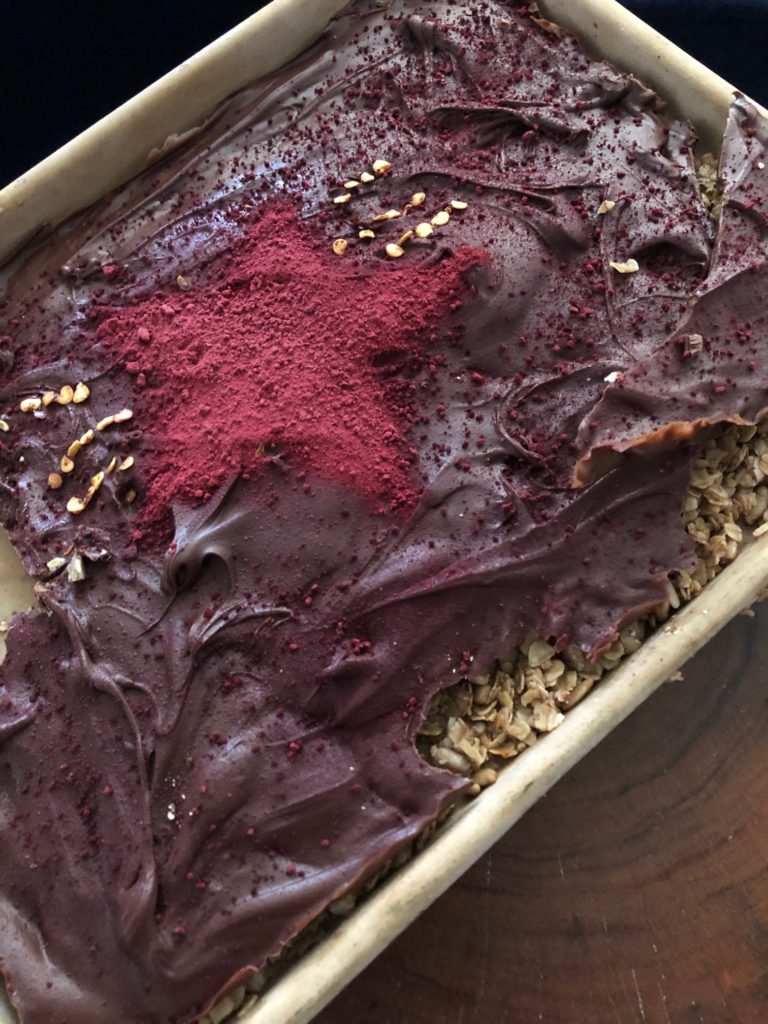
A falling star has a curvy trajectory so you could model after that. Like these curves made with chili pepper flakes for a chocolate granola snack. I made the star from beetroot powder that’s a great balancing ingredient.
Falling star beet granola recipe below. 🌟
In the Falling Star pose, like the Wild Thing pose, you choose. You can slightly adjust your Wild Thing pose into a Falling Star to get pose variations. Vatas love that 😊. You can stay on the floor with your legs and arms widely spread out… or leave just one foot and one arm touching the mat.
When mindfully present, this is a great way to empower yourself and use your body and yoga pose to show off your intention in case you’re wondering what practical application this pose has.
And you can also choose to start over in a grounded standing position. Start in a Five-Pointed Star Pose where your two legs are spread wide apart beyond hip width, two arms stretched out to the sides. And your head makes up the fifth-star point.
You are a star! ⭐️
For your freestyle Falling Star, maybe you’re leaning or swaying even if ever so gently to one side, comfortably balanced, and letting go of the opposite leg and foot from resting on the floor beneath you. You don’t need a mirror to feel lighter and to trust your instincts.
This is a good metaphor for how letting go can be freeing in your life. You can fall away from getting in your own way of anything holding you back.
Letting go of outcomes is one of the hardest things in life I found. It’s not easy to let go of something you want to happen, especially when all your life you’ve been groomed to be in control. But that openness allows for something better to come along.
Sometimes we’re not thinking big enough. So in those times especially, being in a Falling Star yoga pose can be therapeutic and a good reminder.
Another Falling Star variation is to sway and bend your torso to the side a little or a lot (like how a palm tree can bend to withstand tropical storms). 🌴
You can also reach your helicopter arms out or up to help you balance. It’s not about how bendable you are. It’s that you’re willing to even try it!
You’ll get more flexible as you stay in the pose longer. It’s your unique Falling Star creation. 💫Just be sure to have fun! 🌟
And you can do that with this fallen star beet granola pan you can make in minutes with a few ingredients.
Combine dry ingredients and then mix in wet ingredients.
Bake granola for about 25-40 minutes at 325°F or until toasted.
To make chocolate topping. Prepare chocolate on display pan you will be using. Take a piece of plastic wrap and put on top. Add melted chocolate and pour onto plastic wrap. Refrigerate until chocolate is hard. After granola is baked and cooled, you can pour into the pan and then add the hardened chocolate ontop removing the plastic.
To make beet heart: take a star stencil or make a star cutout with cardboard. Add beet powder to create star shape. For fallen star effect, use tweezers to pull out the yellow pepper flakes (found in crushed red pepper flakes) to make a fallen line.
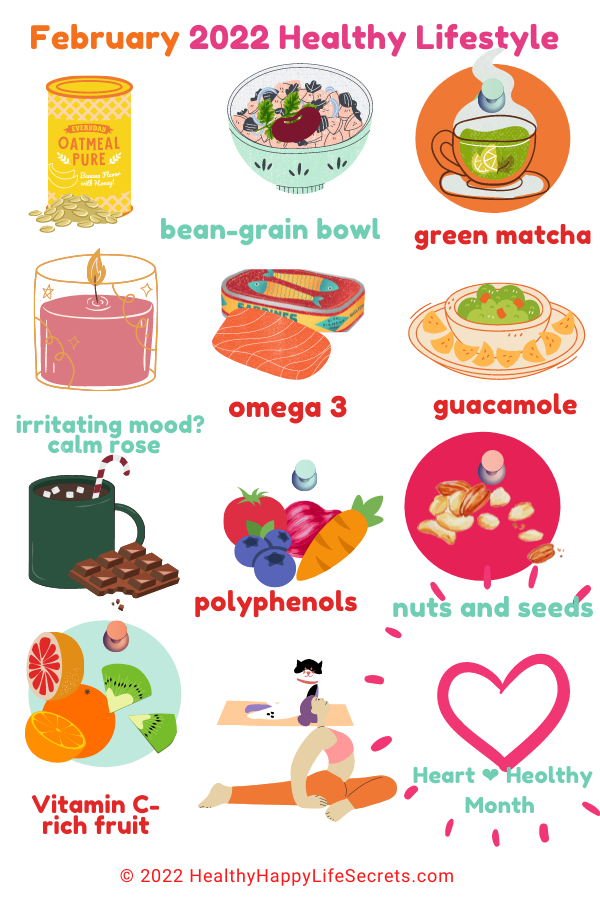
Healthy eating starts with a lifestyle plan. And having inspiration helps us to stay on course like a visual or reminder.
February is heart healthy month
If you want to balance and optimize healthy eating and tasty foods, this article is meant to help encourage you.
I’m convinced you can fulfill both goals at the same time because that has been my practice and desire for my entire adult journey.
I’ve enjoyed and been enamored with foods like most people who think they have a deeper relationship with food (as a lifelong companion of comfort, love, and joy).
I started my young career around my passion for food in event planning, seeing through a “foodie” work lens in the kitchens I worked beside along with thousands of event hosts and planners.
I can’t think of one instance where healthy food menus were requested for the larger ballroom and banquet space events.
But, when I planned parties in restaurants, the healthy menu requests became more obvious.
Like in the Mediterranean restaurants that use healthier ingredients, methods, herbs, and spices. They used EVOO and vinegar bases for dishes, instead of creamy-butter sauces.
That aligned with a healthy identity I was evolving into where healthy foods can be good and better-tasting than non-healthy.
Plus, healthy eating is easier on the body where you and your gut get along better in happy and healthy agreement.
Reflecting on this, I think it starts from appreciating food and the body.
That’s where a healthy balance and triad relationship between you, food, and your body are daily observed from a mirror and a nutrient absorption lens (that only the body sees).
When we have a healthy eating lifestyle, then we don’t have to let the next evolving health trend (or diet) impact us so much or at all. It’s sustainable until we choose to change our plan.
We can change one food or category under question or change, and rely on the variety of others.
Maybe you remember like I do when nuts were considered bad for you because of the fat content, and now they’re the hero of healthy fat and snacks.
If you eat them along with the right foods (like fat-soluble Vitamin A foods), they synergistically help your body.
From your body (aka the end-user or the health critic in you), it’s smart to know how foods are better absorbed from a nutrition-biology standpoint.
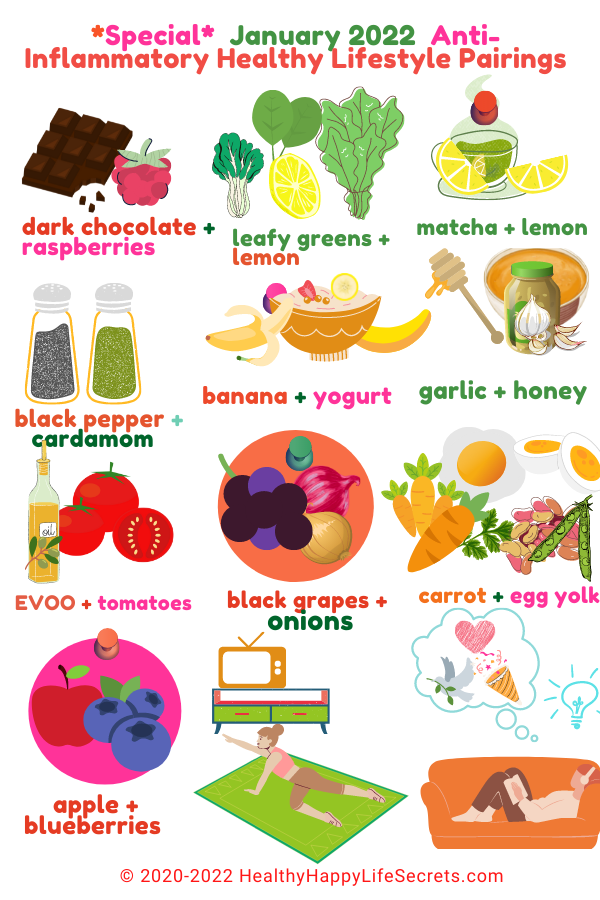
I made a visual of some of these researched nutrition synergies that you can take healthy advantage of.
Some are palatable for pairing, like chocolate and raspberries. A few are odd and you have to really get creative to appreciate.
For those, instead of trying to put them together in the same dish, you could figure out how to start with one and end with the other.
Your gut doesn’t care what it looks like on a plate. It cares how it mixes together in your mouth and ultimately in your stomach.
It helps to be informed and to listen to your inner gut if that’s a strength for you.
If that’s not so easy or has not been helping you out much lately, then eating “from the rainbow” and having healthy eating habits is a good start.
You can turn a boring broccoli side into a delicious soup or a can of pinto beans into a zesty dip.
Both are then easier to digest and you get to enjoy better. That’s just a couple of examples of how healthy eating can be delicious.
Sometimes it just takes a little thought and food prep. It’s encouraging we can reset and start over each day with new healthy eating goals.
In my younger years, I studied the French language, and that helped me to learn catered dishes back then with French titles and names like hors d’oeuvres and foie gras.
The French are also known for their buttery recipes and patisseries, where a bakery is on every Parisian corner.
So, it’s interesting their obesity percentage stats are lower than we have in the U.S.
One reason for this is that French people eat smaller meals and take time to enjoy the bites.
They slow down to chew and appreciate food aromas.
Paris has the pace of living similar to a smaller metro city in the U.S. where the emphasis is on quality living, and not just immersing in the hustle and bustle.
French foods revolve around the idea of high quality over high production. There’s a respect for ingredients.
They have a different way of seeing and appreciating the food they eat. Take cheese: they use the highest quality milk to make their cheeses. And in our American factories, we turn the lower quality milk into cheese.
In the U.S., we love our convenience, fast-paced, and relatively inexpensive options. And in our Melting Pot culture and diversity, we have many cooking influences that help bring back helpful balances.
And each of us can get interested in the nuances behind what we eat, ingredients, cooking, and knowledge. And that helps to become healthy eating inspired. It’s a lifestyle choice.
Each day, it starts in the morning. Breakfast can be nourishing like a protein-rich smoothie.
You can choose a prebiotic-probiotic combination. Examples would be starting your day with oatmeal or a banana and yogurt.
Then rolling into lunch, you can add a healthy eating menu: cooked red onions with fermented foods.
It’s easier to make your own fermented foods than you think as they’re not advertised everywhere like fruits in a produce section.
These days, many of us are into sustainability and feel deeply for the climate changes we’ve seen especially over the past couple of years.
We value recycling despite knowing our efforts of placing our trash in the right bins are limited and we have almost no control.
One way where you can do something about this is to reuse grocery containers for fermented foods that are healthy for you, us, your gut, and the environment.
You could make simple sauerkraut leaving the slaw in a jar of water and salt out at room temperature for a few days and then refrigerate.
Your slaw tastes better and has health benefits. Plus you salvaged the jar as a bonus.
When you make healthy eating changes, in the beginning, it may seem odd to you and your stomach as you both adjust.
You can gauge how this impacts your daily gut and entire GI system and see how that lands.
All our bodies are different (e.g. we’re all given different metabolisms).
But our bodies are similar too as we have the same systems and needed organs to function.
So what works best for one person is different for another.
But I think too often we reject ways that could work for us because we don’t see the benefits of it working out for us or our busy lifestyle, and so we skip the healthy habit and lose out on an opportunity.
Another worthwhile cause (and food for thought) is snacking on healthy snacks like carrots and hummus every few hours in the day.
I think many would have their weight goals met as the body is happy with the food energy boost, and thereby fed assurance that it won’t need to go in survival mode.
Plus, it wouldn’t have to process as much food in one sitting.
…Retraining our body, restoring our body-minds and learning how the body functions along with the world can make a difference for all of us.
Positive thoughts like “you got this” can make a positive impact in your day.
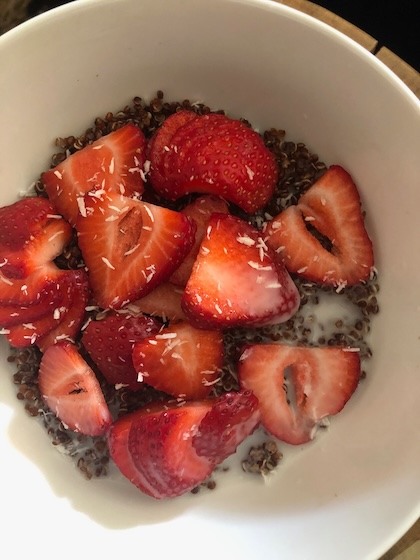
And starting your day with a heart healthy recipe (🍓 below) like this delicious quinoa bowl breakfast idea to get excited about.
Easy strawberry quinoa cereal recipe below. 🍓
If you’re wanting a better day, you recognize the difference between positive thoughts and negative ones.
Thoughts all start in the divided minds we’re given, that’s either hurting or helping us. And if this is new territory for you, start there.
Maybe you recognize which bucket your negative or positive thoughts belongs in, but you don’t know how to toss out the draining ones.
They can show up anytime: when you wake up on the wrong side of the bed or when triggered by a memory, situation, or person.
And then the subconscious mind (ego) feeds off the nourishment of holding onto negative feelings or pain as a form of protection and masks its agenda from you. But now you know better.
Bypass the unnecessary time wasted in dramatic sorrow. Be proactive with positive affirmations, meditation, yoga, or healthy distractions that are great ideas to reset and get rid of thoughts that have no good business being with you in the first place.
Sounds like a plan, right?
But then going about your day or even seconds later, new thoughts occur from news headlines you read, someone offends or irritates you, a situation stirs an emotional chord, and then you’re right back to negative thoughts and moods. It’s daily and non-stop.
Your mind and the negative thoughts grow even if you think you’re living in a safe bubble.
The unhelpful thoughts never have a chance to go away until you decide the one thing you can change and have in common in every thought is YOU.
And so, I share in this detailed blog article what needs to change to get the happy and helpful thought life you want.
This is the second part of the article from last week on relaxing your mind for the best ideas.
Managing thoughts is essential for lifelong learners, and as a prerequisite to being your most productive self, unleashing your creative self, attracting people to your energy, and living your optimal life.
Years ago, I thought traveling to exciting, new places and feeling in woo would conquer negative thoughts, as they temporarily disappeared when senses were heightened (like when you’re newly in love or starting passion work). But those fickle feelings don’t last and things always change after the newness wears off.
So then I dipped my toe in collaborating and aligning myself with the Universe and how to manifest the best life (that’s woo woo to some).
For me, I was on the right path and things were looking up, but I still had to do the inner core work in my mind.
When all that eventually clicked together, then I could feel the woo hoo! And that’s what we all can celebrate in our lives if and when we get there.
It takes all the pieces–knowledge, process, and application. And if you’re feeling lost, it helps to have a guide.
These are a few guiding and starter points that helped me and hopefully can help you or anyone else who’s trying to figure out a better (thought) life.
The first part can be the hardest–knowing that it all starts in your mind and not someone or somewhere else.
This seems elementary after you learn this, but the ego wants to steer you in another direction like something else is the cause or problem.
So if you’re busy or not paying attention, that can happen and go on until you’ve had enough.
Another point is, don’t let nagging thoughts (or drama in your mind) that won’t leave you alone play out for longer than needed which is no more than a minute.
And in relationships, especially. It takes just one step to cross the invisible boundaries of another person with your words that originated from thoughts.
Walk away from your thoughts to give yourself more peace. Below I have some suggestions on what to do.
So, How to Change From Negative to Positive Thoughts…
Our thoughts are natural to us, and they cause us to take action that can appear inconsistent or as disconnects to others.
To change this, operating from awareness is imperative. Initially, this may feel like work and working harder (like walking uphill with heavy boots instead of sliding downhill). But it’s totally worth it.
You learn a life skill to purge those unwanted thoughts that pop up impromptu and when triggered.
I think there should be a required course on this that you learn early on (and would solve some of the world’s problems as people are the problem or solution).
But anyway… changing thoughts gets easier when you’ve learned the skill and it becomes more automatic.
The negative thoughts won’t disappear immediately, but much quicker than before in your thought choice, and you’ll be wise enough to know you don’t have to act out or say aloud negative thoughts.
Which btw, doesn’t change your personality. It makes you more attractive to the right people.
And that’s part of what separates our discerning brains from animals, young children, or when we were younger…
We all started out immature compared to who we’ve become today.
So here’s how you can reset and get your loving daily juice. To promote loving thoughts, witness your thoughts (I’m sure you’ve heard of this).
Practice being aware of what’s coming in. If it’s garbage, then reject or walk away.
If it’s something that you have feelings about and need to process or work through, then allow yourself that grace.
Again, you don’t have to air your thoughts to anyone, and not putting energy into negative thoughts is going to help you avoid wasted time.
Let them pass through and find the loving side of those thoughts (i.e. how can these thoughts help me?).
In the beginning, as you’re learning or practicing, you want to draw a line in the sand and separate thoughts as helpful or hurtful, good, or bad.
Make it easy on yourself and not leave thoughts in the confusing gray zone that’s part of the baggage carried around.
And let’s be clear, these are thoughts and not the actions that could follow. We want to nip them in the bud.
The good thoughts you accept and the bad ones you reject for your own good. If it hurts others, then you toss in the reject pile and you figure out a win-win or kinder way to confront if that’s needed.
Ask yourself daily and often: What just came out of my mouth and what’s going on in my head? Hit the archive button if it’s a worry thought until you can find answers, and hit the delete button if it’s a harmful thought to you or anyone else.
Know those thoughts will still be there if you need them, which you won’t, but your brain tries to convince you that they’re important to protect you when they’re not needed (for survival). You can blame the ego (yet again) on that.
So, after you start to live life this deliberate-thinking way and focus on positive thoughts, you can see the difference in the quality of your life and the better air that’s there.
You’ll feel more peace, and that helps your stress level and health.
You allow room for ideas to come in, and you become more useful to the world with your abilities. You become part of the solution.
Find A Mantra for Positive Thoughts
Pre-social media days, we were not part of an aware culture like we are in today.
In those days along my journey, I came across these words: “Whatever the question, love is the answer.”
I don’t know who the author is that wrote that, but I knew back then that I wanted that. So I printed out and framed those wise words that are now ingrained in memory.
With intention, I used that as my mantra. And even though I didn’t know how to apply it in every difficult situation.
I knew that if I aspired to the meaning behind the words, it would one day catch up with me and my self-actualized desires.
So, if you have similar aspirations of a learner mindset, find a mantra or intention (or use the one I used) to go to if you’re trying to change to more positive thoughts and aspirations.
It can be used as a distraction from negative thoughts. And you eventually become your words and what you think of.
Use Your Internal Guide
As mentioned, it can be helpful to have a guide and for those ahead of us in certain areas and times in our lives.
But the best overall guide is your internal compass.
But we want to change them because sour moods can crowd out positive thoughts and exacerbate our need to judge, be critical of others or ourselves, and get easily irritated, which can cause our negative words or actions.
Being in healthy alignment with yourself is better because, in the end, you and your caretakers are the only ones that will be with you.
You’re the only one that’s with you (and your thoughts) always, wherever you move or travel to.
Sometimes, listening to your internal guide can be countercultural and a bit uncomfortable when you make decisions that aren’t popular or go with the flow.
And especially if you’re a harmonious or extroverted person who just wants to get along or people please.
That can make it difficult to live in integrity (doing, saying, and thinking the same thing).
Robots will have it easier than us in this way, but sadly the tin man is missing a heart. 🤖
As humans, when our thoughts don’t align that’s when we have a new chance to re-adjust.
Years ago, no one talked about mental health or wellness as part of the daily talk. Now we embrace “knowing better” in our lives.
We don’t have to just take our thoughts (or others at face value) that turn into actions that don’t always get good results and can even get us in trouble in a hyper-sensitive society.
Plus, we have more options to change the channels in every sense. And we’re more accountable.
We need this accountability. It makes us better as individual people and all together in our complex world.
So these are some accountable thoughts and maybe some personal growth homework (should you choose to accept the mission?) for turning sour cherry thoughts into sweet ones.
As a bonus, you’ll become a better person as a byproduct. I know because this is all stuff I went through. It takes one to know one, and we’re all here to figure out our best life and selves.
So, no judgment here (and actually that’s one of the assignments) 🧡 That’s a balanced Pitta way.
Pause on the gossiping:
Here’s the better way: if you wouldn’t share the news with others and the person you’re gossiping about in the room, then find a way to filter and say less.
If you’re not sure, ask.
More likely you’ll just zip your lip and that’s fine too. It’s really that simple. But even simpler is just not gossiping at all.
That becomes an automatic, better way.
When you find you can’t sit and talk in the same conversations with those who gossip, then you know you’ve changed that about yourself.
You end up productively filling your time with better ways that lead to better things.
Learn to not judge:
We never know the full picture of what’s going on with anyone else no matter how much we think we do.
Take the objective and loving-kind stance.
If you want to have an optimal life, the sooner you learn to let go (of judgment) and to stop controlling so much, the sooner that will start.
A prerequisite for this type of freedom (that it is), is to stop judging others at the first judgmental thought that enters and let the negative thoughts pass through.
Quit complaints:
If you say negative things, then you become a negative person when what you really want is happiness.
So if the first thought that enters your mind is to emphasize complaining, that hurts you.
Maybe you’re used to complaining to get your way (and learned the squeaky wheel gets the grease).
But also what’s happening in the process is you’ll be seen as a complainer.
People who don’t complain will stay away from you, so you’re in company with complainers or those who want you to complain for them or their causes, bringing more negativity in your life and less in theirs.
…If you can make these 3 life changes, you’ll be well on your way to a more peaceful life. It’s simple, but not always easy in the beginning.
It takes desire, self-control, and holding yourself accountable. Be patient and easy on yourself. The good news is these traits are changeable with practice.
And if you find people to support your efforts (and let go of the ones who aren’t), it’s easier.
Your supporters are your best allies.
Ultimately you decide what type of life you want to live. You get to decide what thoughts you keep. Copy that. 😉
Healthy Chipotle menu, healthy fast food, and healthy eating are all related. Chipotle makes healthy chips and chic beans in a pot. And they make it all so tasty good.
These are the same type of ingredients used and eaten that the longest living people on the planet today enjoy.
These folks are also some of the poorest which debunks the myth that you have to be wealthy to be healthy.
And one of the plant-based healthiest meals that’s full of protein amino acids is the 3 Sisters dish traditionally with corn, tortilla, and beans.
When you’re not at home and making eating out food choices, eating whole grains and more plant-based is part of healthy eats, and the Chipotle menu is one menu to consider for a fast lunch.
I wish they were around when I was younger. For elementary school field trips, we were asked to bring a bag lunch to school (…you may have done the same).
Most schoolmates had white bread sandwiches (the magical Wonder Bread enriched white bread) and were less likely to stand out and be judged. For lunch hour, your pride and identity were wrapped up in 2 slices of bread, lol.
Today, bread shaming doesn’t cut it …but I know the feeling as my sandwiches were made of whole wheat. Back then, I guess that was better than the occasional super healthy alfalfa-stuffed and sprouting kind where apparently the parents were on a healthy agenda (and didn’t get the memo).
And once in a while we had Taco Tuesday lunches where they offered hard tacos. Some preferred soft tacos. It was kinda like white vs. other breads.
These days we’re open to anti-inflammatory variety, and being more planet and health-conscious. And that’s reflected in our visible fast-food options.
Besides just breakfast, lunch, and dinner, sugary dessert yogurts have been replaced by fruit smoothie energy-vit-enriched powders, as nice in-between options.
Growing up in the DC suburbs, we didn’t have healthy build-it-meal places like Cava, SweetGreen, or Chipotle, or fast food places that offer plant-based meals.
No fast food place offered salads or greens, or at least fresh ones you wanted to try. And that’s coming from an area considered a cultural mecca (and foodie hub). Many field trips were to the DC national museums where we only had time to eat what we brought.
And health-conscious calories and nutritional meal information weren’t anywhere to be found (heck, we didn’t have internet). We’ve made leaps and bounds to become a more health-conscious society.
Living past 90 and 100 is a higher probability than it once was. And from all the living longer information available to us, we know life expectancy and maintaining ideal body weight is mostly determined by personal lifestyle choices.
So thankfully our society and the food community are rallying to help this cause. Aligned to this, the Chipotle menu offers a line called Lifestyle Bowls for healthier eating habits (that end up as regular eating behaviors).
Our bodies are resilient, and we know we know we have some control and can restore our imbalances through the mind-body (or body-mind connection). We also know our thoughts turn to feelings and our feelings to thoughts that can help us most if we’re aware.
These concepts I’ve grown intimate with because I’ve learned they are keys to helping unlock happiness… why live a day here dissatisfied if you don’t have to? And what you store inside impacts your health, in the one body you’re given.
And today and every day is a new day that can be a fresh start in a healthy new year or new season. It can be a good time to welcome changes. Food is a great place to start. And I think we can learn a tip or two from the Chipotle menu whether we eat out or cook in…
At Chipotle, like most fast-food chains, you get consistency and know what to expect. Here are some Chipotle menu healthy ingredient inspirations (from building a lunch meal bottom-up):
You could start with a tortilla or with a bowl of rice, where you get to choose white or brown (kinda like the white or whole wheat bread kinds we’ve known since we were kids)… And in adult wisdom and healthy gratitude, we know choosing brown rice goes much further in the healthy zone! 🦷
Chipotle also offers beans (that are often found in Mexican dishes). They offer two types (black or pinto) for simplicity, but did you know there are over 16,000 types of beans (and 40,000 varieties if you Google it)? In a Western diet, you and I have probably only encountered or eaten closer to 16 kinds. 😊
And just looking around, our American diet isn’t a bean-focused society like other countries. Chili is the glorified bean meal we tie to social occasions and sporting events. But, on the Chipotle menu, you also get the choice to add beans as a rice topping, plus another protein choice that’s considered the actual meat or star protein.
The added beans on the Chipotle menu are subtle but may be your only bean source for the week or month if you don’t get them anywhere else. Just sayin’.
And if keep going down the build-it meal line, you can add guacamole that has tasty value. You don’t necessarily think of the Hass avocado source that’s the add-on’s main health benefit.
From there, you can build in green lettuce, a corn mix, and other daily made healthy toppings with herbs like cumin, oregano, and thyme. And all kinds of mild to hot peppers.
That’s as close as it gets to healthy fast-food eating out.
I compare that way to my restaurant event planning days where I was around exotically delicious food all day (Spanish, Lebanese, Italian, and North African cuisine), but not all of it was healthy. It was a mixed bag mostly from the fried methods or rich sauces.
In the Chipotle recipes, they make a point to use health-conscious sauces. Soffrito is a Spanish sauce and Chipotle has sofritas as a plant-based protein option.
And now they have a second-plant based protein: chorizo (plant-based inspired sausage). Seeing a trend emerging?
In my area, you don’t have to go far to go to places like Cava, where you’re getting fast-food metro- suburban Middle Eastern chickpea falafel. You can also go from bean to chickpea legumes on fluffy basmati rice that you can make at home. Or make cute and easy 2-step rice balls.
Or choose Sweet Greens, a salad, and green-grain bowl place that loves heirloom veggies (like in their Harvest Bowl). Ordering can feel like you’re picking from a California leafy green and veggie garden (and even close to the ground with their Shroomami or Curry Cauliflower bowls).
Then when you’re ready for something sweet, you can find smoothie places with tropical fruits and powder infusions. In city-metro areas, there are many to choose from, and you can add your chia, flax, and sunflower seeds. These are all mainstream now, but once upon a time they were exceptions.
Maybe reflecting on your food journeys and looking around your neighborhood food options, you’re a bit more inspired to eat a little more healthy Chipotle menu-inspired.
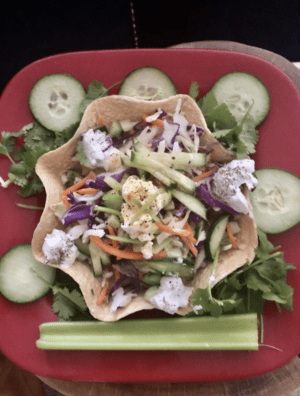
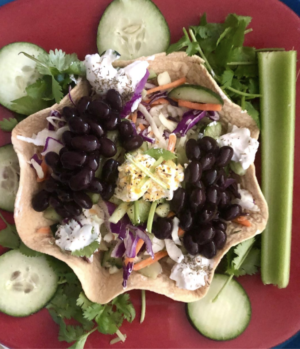
That could be a healthy step forward in your home tortilla meal and bowls.
You can eat more beans, tortilla, and plant-based goodness that good for you and the planet.
Bake tortilla at 200°F in bowl shaped baking pans or oven-safe bowls for about 60 minutes. Tip: since you will baking at low temps you don't have to go out to buy special pans if you don't have them. Many eating bowls have oven-safe labels at the bottom of the bowl.