
Green cabbage that’s fermented (aka sauerkraut) is a healthy way to to start your day that’s easy to add to your meals and toast. And turn into kimchi.
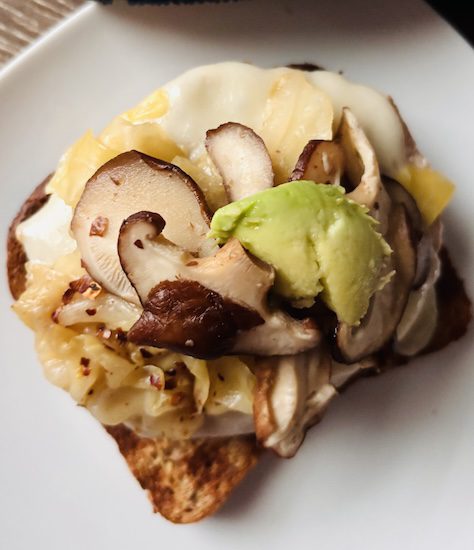 Fermented cabbage is the crudite (raw veggie) that can go underrated considering how good it is for a healthy gut mission.
And happy gut, happy life.
Plus, it’s also an easy way to not have to cook the cabbage (or turn on kitchen equipment like the stove), and have naturally softened cabbage as though it were cooked.
The only thing fermented cabbage takes is a little time (days), salt, and a container. Then you’ve got sauerkraut (like the kind you see on yummy TV Diners, Drive-Ins and Dives’ meals).
That’s the first fermented cabbage to try to make for fresh meals.
…The new TV dinner.😊
To make the sauerkraut, you can use common red or green cabbage.
You can leave a container of the cabbage covered with water and a little salt at shaded room temperatures. If you leave it out for 4-5 days, you may notice some black spots that look like cabbage leopard spots
I used to throw those pieces out, but I learned that it’s not what you and I think it is.
It’s part of the oxidation process (and not about spores).
Plus, since fermenting is the goal, growing bacteria is par for the course.
But to put the mind at rest, most clean cabbage black spots are safe to eat if it’s developing over a few days and you can cut them out for aesthetics.
You may also see a strange milky film growing in the water that you can simply skim off and replace the water.
These are common possibilities for fermented cabbage.
But there’s no time-temp formula that’s 100%, and I like to keep mine less wild under a week.
That’s why I never let the fermentation get sour, like sourdough.
Because then you can also use your nose to say “no’s” to your fermented cabbage. If the smells are going south, then you know to replace some of the water and/or refrigerate the cabbage to slow down the bacteria growth.
You can usually save your sauerkraut or kimchi if you haven’t left it unattended beyond a day or two.
For some, that can be comforting that it’s a controlled science experiment that won’t go to waste.
And when it’s ready to plate up, the benefit you get is you add good bacteria (natural probiotics) and support gut balance for your gut.
You also help support your weight with the good amount of fiber. And you build up your body’s immunity and with antioxidants (vitamins and minerals).
Fermented cabbage helps protect against free radicals that can build up and cause chronic diseases.
And your happy center is in the gut (where serotonin is made).
So eating tasty fermented green cabbage can directly affect your happy moods.
Plus, green cabbage is a super affordable way, compared to alternatives such as preventative probiotic pills.
So now that you got all the healthy skinny, what can you effectively do with a green cabbage head.
Besides making sauerkraut or kimchi for your sandwiches, you could take the first few cabbage leaves and make delicious gluten-free wraps like chicken salad cabbage wraps or plant-based tofu chili wraps.
And we’re just getting started…
With the middle of the cabbage, you can roll up the cabbage leaves and cut strips (or chiffonade thin ribbons that pleases my catering roots 😊), with a serrated knife.
Then as you get closer to the center (or the end of the cabbage road) of the unused cabbage that looks like a veggie flower, you can add as edible decoration on a food plate (another catering thought 💭).
Or you can use those lighter color, thick parts as part of your kimchi. They make for flowery textures and irregular smaller shapes that work well on a sandwich.
To make kimchi (the 2nd fermented cabbage way), soak those cut cabbage parts in a umami sauce and water, and add your spices and peppers.
There are so many umami options today: you can use soy sauce for convenience, but if you use fish sauce or oyster sauce, you’ll get richer ocean salty and/or sweeter umami tastes.
And since we’re adding flavor dimension, Five-spice is a great pairing because it has the Asian flavors that come from the Szechuan or Sichuan pepper(corns). This adds a licorice-vibe with the fennel and anise that’s usually in the blend.
It kinda smells like an Asian grocery store if you can’t remember the aroma.
And after you’ve got your kimchi tastes, you can add them to an open-face piece of toast.
I like to toast my bread on my waffle iron along with make easy brunch-style waffle recipes.
I find that the waffle iron heats up fast (like a curling iron in seconds).
But the real reason I like it is because it’s a solid piece of equipment that doesn’t zap out for no rhyme or reason.
It’s function is the same as a toaster but it doesn’t end up in the toaster graveyard like all my past toasters. Those were sad kitchen days.
And unlike a toaster that was part of kitchen (or kitsch) decor, a waffle iron is easy to store (in a kitchen drawer or upright with cookbooks) and is also easy to clean… where you don’t have to push out crumbs.
But that’s something you and your kimchi can decide. And you’ve got a few days, before your fermented cabbage is ready!
Easy Fermented Green Cabbage Kimchi
Ingredients
- 1 green cabbage head
- soy sauce (or fish sauce)
- salt
- spices: cayenne, garlic powder, and Five-Spice (optional)
- peppers of choice (pimento or chopped bell pepper for sweet, or banana peppers for bitter, and hot pepper for heat)
Instructions
- Cover cut cabbage into a closed jar or container filled with water, salt, and the spices.
- Leave in a cool room temperature spot for 4-5 days, skimming the surface with a spoon or slotted spoon from time to time for any new debris.
- Place on your savory sandwiches and meals. Enjoy!