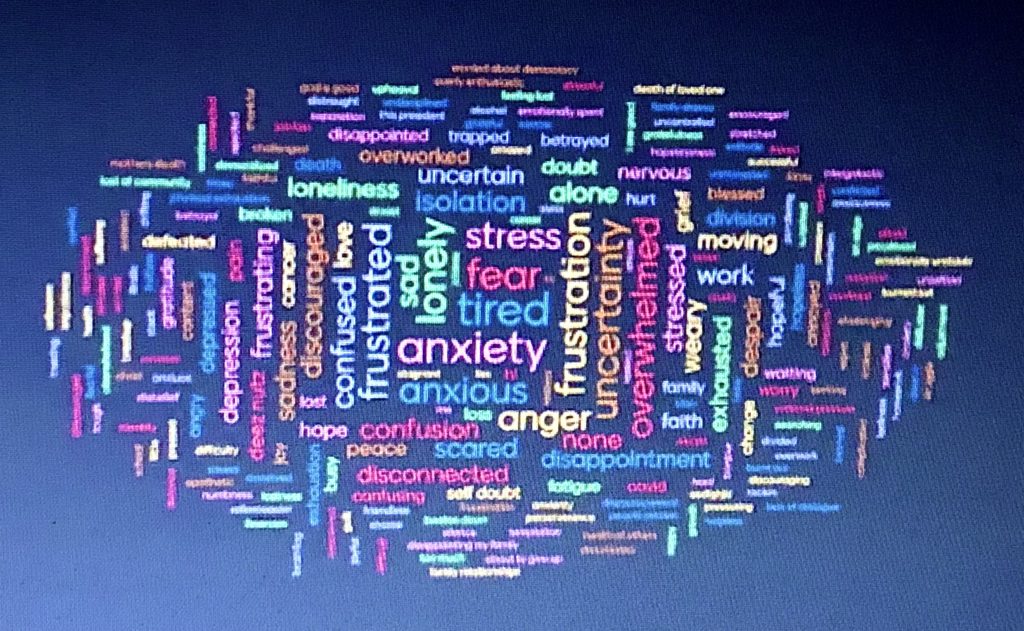
Tired, frustrated, or overwhelmed feeling as shown in this word cloud are general feelings many of us have.
These are eye-opening common feelings from my community surveyed in September 2021
But you don’t have to stay tired, frustrated, or overwhelmed. It’s the start of a new season and you can transition into your best season (no matter your situation). You can handle it with grace if you stay conscious of your attitudes and what you’re focusing on.
How you react is a direct determinant of how you perceive and interpret your situation.
Today’s blog post (and it’s a big one) is all about your different tired, frustrated, or overwhelmed feelings that bubble up when triggered that arise from some form of dissatisfaction (or trigger) in your life. I’m gonna share how to put those non-serving feelings aside so you can LIVE fully!
And that can start with a recipe that cools and refreshes.
If you’re tired overall, then I’ve also got a tea beverage that’ll help put a pep in your step (especially if you have a Kapha imbalance). So keep on reading…
But – just a little side warning upfront: this is a long (and maybe deep) blog post. I didn’t intend for this to turn into an article-length piece, but I’m very passionate about the topic of balance restoration (having suffered in my ways before with unfulfilling work), so I believe that this is useful information for those who want it (and the data is showing people are feeling overwhelmed and frustrated these days).
So to further help with exhaustion and offer some tired relief in the way I know that works, I’m providing some know-how advice and practical nuggets of wisdom that I picked up along my journey.
I chopped up the blog article down into 4 main sections and here are some of the highlights:
Section 1: I explain how feelings can guide you and share what you could productively do with your feelings, plus lessons I learned that can help you turn your life around from tired, frustrated, or overwhelmed feelings.
Section 2: I share how to turn your feelings around with your thoughts and two revelations that changed my life (and since the tennis U.S. Open just ended, I use an analogy from the sporting event to describe how you can improve your thought life).
I also share with you some of my lifelong learner ways you can use to help you turn your life around from tired, frustrated, or overwhelmed feelings. And I explain how to reset your life now to a better path of possibilities.
Section 3: You can learn how to change your moods (whether they’re daily or seasonal moods) and how to use your time wisely with a break pause in your day (and life).
I include plenty of peppery questions you can ask yourself to get to the heart of the matter and find yourself in this season, along with oodles of examples throughout (so be sure to read it all and come back if you need to take a break!)
…and then finally in Section 4: you can learn how to change your perspectives from the tired, frustrated, or overwhelmed lens.
And I wrap up with some joy and inspiring ways you can look forward to your season and the upcoming 4 seasons.
So be ready to be encouraged and if you’re ready, grab a beverage and here we go!…
Bird of Paradise yoga pose is one that should be celebrated. I love this pose for several reasons I share with you below.
Firstly, it’s a mind challenge in a good way… and maybe you want to take the journey to discover more about you and your body!
Bird of Paradise yoga pose is a good metaphor for removing thinking overwhelm and mind blocks.
It’s a personal growth exercise pose.
And one you can practice annually on #InternationalYogaDay to measure your yoga milestones.
Bird of Paradise yoga pose (BOP pose) is great for mind-body balance.
It stretches your arms, legs, buttocks, and shoulders while you’re standing on your yoga mat.
If you’re injured somewhere between your head and toes, this is not one you want to try until you’re fully healed…
I mention that because I recently was injured, and I couldn’t do the pose.
I had a left foot injury where I often had to stand on my right foot without a crutch. I must’ve looked like a flamingo with my one leg propped up behind me resembling the number “4.” 🦩
With injuries, the last thing on your mind can be working out. After you start getting on the body healing path, you can get back, restore, and find ways to work out parts that work.
Working on strength is healthy.
So a good way to ease back into physical activity is with gentle stretches and yoga poses.
When you’re ready, one of these can be the Bird of Paradise yoga pose that helps build strength in your legs.
It also helps with your balance, especially when you need to rely on one side of your body over another.
That’s why it’s good to maintain and build body strength as you never know when you will need the extra gusto… and flexibility and muscle strength in the right places come in handy (even for a small framed person).
To get in the Bird of Paradise yoga pose on one side, let’s say your right side first…these are the steps:
While bending down at your torso, you weave or wrap your right arm under the same side/right leg and then grab behind you, your left hand.
Then without letting go, stand up and lift your right leg straight up. Either let that right bent leg rest on the back of your right arm or aim it up into the air at a pointed 45-degree angle (if you can and wanna show off ;-).
I know it can sound like a game of Twister with yourself, but it’s simpler than the instructions are once you get the hang of it!…
You’re basically hiking that shoulder behind the same side leg — so it can be done in two simple steps. Your leg in the air is more like a front, dangling handbag strap. 👜
That’s where you can overthink the pose. If you’re a newbie at the BOP pose, it can take a few steps like if you were twisting dough into a pretzel form.
…at this point, I’m not sure what you’re thinking about this pose… but hopefully you’re inspired to attempt (and not scared to try)?
If it’s new to you, it was new to me too. I first learned of the pose when they would teach this one in Hatha yoga classes I attended.
We all try and fail and then before you know it, you’re doing it!
And it’s worth trying because besides the stretch benefits, it teaches you to let go.
It’s a good exercise to teach yourself to lighten up and not take everything so seriously. That’s a side benefit.
And when you do that, you’re n the Bird of Paradise yoga pose.
Because when you’re first starting out, you can overthink the pose and not fully get off the ground (floor). Or, you can wobble or fall out of the pose somewhere in the process.
Here’s how you can bypass overthinking the pose… 🧘🏻♀️
You start off standing. Then bending over and taking one arm and threading the same side shoulder underneath the same side knee.
Then stand straight up with the entire leg and same side arm in one fell swoop. It’s that easy.
You probably got that part the first time, but where people get hung up (and I know I did in the beginning) is focusing on the arm and leg and how it would gracefully look instead of just looking straight ahead and trusting all the parts are where they need to be.
It’s about surrendering.
And before I surrendered, I stayed stuck and bent over on the ground.
I was ready to get up.
So I attempted again the next day without giving the pose much thought.
The next time I looked up slightly, and straight ahead with more confidence.
From there it became easy, breezy, and smooth sailing, as I know it will for you too. ⛵️
Also, if you stay in intentional present mindfulness, the success rate to bloom into a flower Bird of Paradise is high. 🦩
If you think of yourself as the flowering bird of paradise planted in life, 🪷 then you can aspire to achieve this advanced mind challenge yoga pose pose more eloquently and efficiently (bypassing negative emotions and confusion).
I’ve done the pose in linoleum floor office workplaces wearing stretchy leggings and riding boots… and I’m no superwoman, so getting off the ground if you want to, can happen for you too! 😊
Just a few final notes and words of encouragement before I close out here…
If you’re on the computer most of the day, the Bird of Paradise yoga pose is a great shoulder opener.
Without awareness, most of us have a habit of leaning forward and caving our bodies inward that isn’t great for our bodies.
Especially by our old age when we need support to balance our bowling ball-like weighted heads (and our shoulders are part of the main muscle group that helps with that cause).
So to counteract or correct bad habit postures, to undo them, bend them in the opposite direction from time to time. That’s a good overall rule of thumb for stretching practices.
Keep challenging and amusing yourself and others around you with your standing poses like Bird of Paradise, Tree Pose, and Dancer Pose. These are other favorite poses of mine..
And if you are having seasonal internal-body symptoms that are preventing you from doing a Bird of Paradise yoga pose, be sure to check out the Body Balance Quiz to learn more about restoring imbalances.
Abandonment is not an area that should hinder you or your growth. Your past is not your future.
Shining light through the ordinary things in life helps create awareness and beauty. Awareness can heal past wounds, and trauma from abandonment feelings.
Our brains keep memories and our bodies keep score.
Your past is your past, but your mind processes random entering thoughts inefficiently, without using an organized filing system (where yesterday’s past can be mixed into today’s thoughts like spaghetti strands in today’s meal).
I know from my past that past abandonment thoughts that hadn’t yet healed can quickly muddy your current thoughts and actions.
Resurfacing pain-filled memories can do damage.
Abandonment Is a Spectrum
Abandonment can be one of those fuzzy and invisibly damaging memories that you may not know you have or are holding onto if you your family stayed intact.
That’s my recollection.
On one end of the spectrum, if you grew up in a foster system or were physically abandoned by a parent, that would no question hurt who you were growing up and you possibly still carry hurt in who you are now.
On the other end, if you had small injuries you couldn’t put a label on with one defining incident, that can actually hurt you more because in the invisible (unconscious) you don’t know you need healing.
And if you have unattended wounds, one day, you can get triggered and start snapping at your partner or a close person, subconsciously displacing your emotions, and blaming the wrong person for leaving you or ignoring your wants.
If you’re aware, you realize that how you behaved has nothing to do with them, but all about you and your past!
Psychotherapist, Susan Anderson wrote in a Huffington Post article, that you could have any of these damaging 40 post-trauma effects that include lingering insecurity, anxiety, and shame.
I felt like a shadow in daily life and on family vacations when I was still in grade school.
That was my an identity memory I held on to until my 20s. And the wound left was feeling unworthy and low self-esteem…
Since then, my scars have been completely healed as I made a point to bring light to the invisible wounds years ago. And as time passed, I knew that what I went through was not a mishap.
Life planned for me to grow up where I did with the parents I had was to help make me a better and whole person that I am today.
To be fully healed and forgiving, helped me to look skin deep and find my second act in this one and only life we have.
That’s the transformational shift that made me take a real-hard second look because I had been carrying clouded insecurities with me in my life, work, and relationships.
Getting to the Root of It All (The Ego)
For as much as I can remember my parents didn’t know how to express love, or give hugs or kisses.
From what I know they didn’t have parents that give them that either.
That was their upbringing in another culture, and growing up in those post-World War 2 times where vulnerability wasn’t a strength (and could be seen as a scandal).
So, my growing up daily around American friends as a first-generation American, I leaned into and went out of my way at time to be touchy-feely with my friends.
Having affectionate expression is especially important when your primary love language is touch (that mine is).
Words are important. Hearing “I love you” comforts the loving part of our mind and affects our deep rooted insecurities.
Love can quiet our primitive ego minds that in any weak moment can deceive and slip us into unhealthy ego fearful thoughts.
If we easily get seduced into a negative spiral, shame trap or think we’re not enough (let alone good enough), we can blame others (or ourselves especially if we’re sensitive).
This is unless in self-awareness, we stop the fearful mind dead in its tracks from the momentary soothing drama trap that we’ve fallen into.
I know I did that for years, I allowed my brain to go where it wanted thinking those were my thoughts. Ha! …but, when you know better, you do better (said the wise poet Maya Angelou).
If the cunning-tricking part of ego in your mind is something you aren’t yet aware about, figuring that out can be a Life Changer for you and save you years of wasting time in negative, unproductive thoughts.
…And when I learned how to transform my mind where the thoughts began, I could be fully empathetic and change any negative script.
In self-therapy with a few good self-help books along the way, I can see my good-intentioned parents. If they knew better, they would have done better.
They are immigrants like so many in America are today. And just by that one-word description, you can guess they had struggles like most of us have, whether we admit to ourselves or not.
So to me, my parents deserve a nice kudos for trying in this one life where we don’t have a manual handed to us.
They could have just stayed behind and never dared to hope and dream.
Instead, they persisted and started a new life in a new land.
They grew up during hardships and heard the sound of bombings living on a Pacific island where they didn’t go to school for several years, sharing some similarities to the pandemic world we’ve experienced in 2020.
They lived in fear during their most formative years when childhood thoughts have a way of settling in deep and for the long haul.
There were 8 in my father’s family where individual wants weren’t met, as their basic needs were only met with limited resources.
They didn’t grow up having preferences and they experienced times when they only had a small meal each day.
After they immigrated decades later, they had to figure out the American culture when they were almost mid-life adults, landing during the chaotic 60’s and Kennedy assasination (a crisis in itself), and the Beatles era where social reform was a norm similar to today.
Learning to drive a car for the first time in a foreign land, and trying to provide for a family of four during a 70’s oil crisis and recession when I entered the picture, must’ve been hard.
From that empathetic lens, I understand why there are only two baby photos of me (and probably contributing to why I love photos today).
They traded one struggle for another. In life’s difficulties, they sought to find normalcy, provide a roof over their heads plus for my sister and I, put food on the table, and raised a family.
All these points I just mentioned, a high ego mind hates to hear as that releases blame.
But if everyone could let go of blame and offer forgiveness for the areas in their life they’re most emotional, heated, and passionate about, we’d have a more peaceful world.
From Abandonment (Victim Mentality) to Learning Abundance
My parents’ mindsets were filled with not having enough..
I sensed their feeling of lack growing up, so I never asked for much and I knew I had to forge my own paths and resources.
I couldn’t live from their paradigms and limiting beliefs and I had to create my own.
And I thought I was on my right path, until I was blindsided that I held an invisible victim mentality.
But that was the cold, hard fact that came crashing down on me when a mirror was shown to my face. I had mixed messages in my mind of my past and current life reality. In my mind, the clouds were in the gray mess.
The Cloudiness In Not Having Defined Labels
On the outside, I was aware I was strong-minded and confident, and on the inside, but I needed past parts to heal that hadn’t been addressed.
When unexplainable anger and anxiety emotions bubbled up from nowhere other than a small trigger, I learned how to cope. That’s what we all by default do in our own way if we don’t know better.
I thought that was just the way I was.
As an adult I recalled memories to help me see my wounds. I needed the wounds to scar. A vivid memory I recalled was when we took a family vacation to Disney World.
I remember I was unhappy at the Happiest Place on Earth because we spent all our time at Epcot Center (learning different cultures). Today of course that would be exciting to me.
But in my young mind back then, by the end of day because of my passive whining moves of staying extremely quietness (I never whined, I was invisible!) we ended up at Magic Kingdom.
I was hoping my parents would notice something was wrong with me. My dream came true.
But back then I felt guilty for taking up time and space (my invisible identity kicked in), so I didn’t have ideas for what we would do in the Magical Kingdom. Part of my immature child’s mind was still in shock that we were actually there.
I wished we could have had a more fun family day, but looking back now, I’m grateful we spent time at Epcot and that’s where I’d be today amongst adults if I was at the park.
And maybe that was formed from the memories I had.
But in healthy awareness today, it makes total sense for a child who felt abandoned to have reacted the way I did, especially after I learned decades later there was such a thing as a PTSD of abandonment label.
I don’t like labels as I think they grow the problem, but that’s a good description.
Learning this label exists brought the trauma to light and also reinforces there are others out there who have experienced similar trauma.
Had I known thiat in my 20s, that would’ve saved me years of grief.
Today I’m grateful of the discovering journey I went on to be where I am today.
I’m also convinced you can speed your discovery process up in your life today if you want to.
What Awareness Can Do To Help You
When I became aware, I learned how to speak up more and take up more space.
And I’m grateful I have my vacation memory that helped shape my gradual abundant mindset transformation, that btw, you can change inside you no matter your situations.
I also healed my abandonment childhood wounds instead of allowing my mind to rationalize a past memory as a silly thought I had decades ago. I took it seriously.
By doing this, I ended future material that the ego could have had a field day with (and over and over again!).
It’s best to get it all out in the open to yourself as a real story you lived through, so you can get mind-healthy, and be in control of your destiny.
…Otherwise you can go on living invisibly damaged.
Your invisible abandonment and other childhood traumas can be something you heal yourself from, so your wounds become scars that you grow and learn from, and you become better than when you started. That’s how I feel.
If you have feelings of abandonment, here are a few productive actions you can take today from my lessons learned:
4 Abandonment and Healing Exercises and Freeing Questions to Ask Yourself
1.Witness negative thoughts that arise that turn into negative emotions. Use those moments to ask yourself, “why am I feeling this way?”
Because in most situations others wouldn’t react that way. This can center you to be your own healer instead of wrapped in the drama of your minds’ thoughts.
Question and wonder if your today position in your situations posing conflict comes from the needs and wants you didn’t receive from your past. Likely that’s the case.
2.Remind yourself to distant your Younger Self mind and thoughtsfrom your forming better ones (that turn into attitudes and habits).
If you find yourself behaving, mimicking, or sounding like a child reminiscent of when you were younger, then that’s a sign that healing is needed somewhere along the line.
Because having fun doesn’t mean acting like your younger (immature) self when you were younger.
That’s a reflection that there’s a missing piece to grow into who you want to be and become.
Consider if you were playing with a child, you’d play with the child in a way that entertains them, but you wouldn’t mimic to them how you sounded when you were 4 years old, but could change your voice to a Muppet or cartoon character for entertainment value.
In this mature way of an adult acting playful (child-like but not childish), you’re drawing from a present place of creative acting, and not from your 4-year old mind.
Today is a new day, but you have to tell your mind that constantly so it becomes automatic. Also, keep questioning why you act or react the way you do.
The old brain files never get completely deleted but they can show up with new insight and then get re-archived, so the effect they have is more historical fact than attached emotional turmoil.
Think of when you tell your sad story the first time, you may have trouble forming words over tears or anger, but then if you were to give a Ted Talk, by practicing over and over again, the story becomes less traumatic if you keep re-telling your mind-body-soul the story in different, impactful ways (getting rid of every last bit of pain and resentment).
Life is better, and the old you and life are gone, so keep reminding you old brain and self that you’re safe.
And that abandonment was in the past, even if your pain happened last year from a loved one. You’re great and free now.
You’re a new person today and remind yourself how far you’ve come with change and transformation you made.
Keep committing to growth and change.
3.Observe and be aware when you react a certain way that creates discord in you or with others. Is how you’re behaving, rational or fearful baggage you’re carrying?
Because with others, you get a mirror reflecting back to you.
Asking non-judgmental questions to yourself and to them is a better way.
Compare how you would ask someone you didn’t know the same question (in a more guarded manner) and to your familiar tribe where you are more vulnerable, intimate, and the veil is removed.
4.Focus on each person’s positives. We can be expecting more from loved ones, and then focusing on differences instead of the initial similarities.
In long-term relationships, you adopt the others’ views as your own and what you both think, but that’s not the case at the beginning where the power struggle can be debating who is right or wrong and where emotional hurts are announced.
The reason cuts are deep is because you care. And sometimes to be empathetic, you have to let go and not care so much, so that there’s a chance for growth.
That’s how you can grow and heal from childhood wounds.
What if in my story I chose to look at my life as a gift, and that it wasn’t up to my parents to meet my wants and that they gave more of themselves in this world by having me, their second child.
From that perspective, I would release abandonment and blame.
What if you could do that for all aspects in your life that you are and aren’t aware about, wouldn’t that be great?
Final Thoughts
And lastly… if you still struggle to figure out why you’re anxious or have frequent outbursts for no reason that you can’t pinpoint why, most likely they come from your way back past and are tucked away in your old brain and need healing.
You could ask yourself: did you ever feel abandonment?
That could be the start of your healing along with purposeful shadow work.
In my life, I first noticed my performance anxiety early on when it came to test-taking time in school.
Since then I figured out that performance anxiety comes from panic, perfectionism, and overthinking. Those all had one thing in common – my mind.
That’s where it all started when I believed I wasn’t prepared enough.
That set my subconscious mind sending unclear messages that left me in an internal nervous frenzy and blowing up into anxiety and panic, which further prevented productive rational conscious thinking (and maybe this has happened to you also).
All through childhood, I grew up achieving ideal perfectionist standards that aren’t so easy to shake off as an adult, even with constant reminders.
But doing it imperfectly and progress over perfection is the better mantra way, that has also changed in schools.
In school terms, that’s being a “C” student and passing, over being an excellent “A” student as the only successful path.
A few years ago, I may have cringed at that thought. But we’ve turned into a more empathetic world that allows us to be brave and follow Nike’s long-running ad advice, just do it.
There are still times when you’re asked in your work to strive for perfection. On those occasions, you’re asked to nail the performance or delivery, and you’re not gonna turn down the ask if it’s your employer.
But if it’s self-imposed, then that’s something to be observant about and look out for.
You can ask yourself why you didn’t hit send or complete the intended task imperfectly. That’s what I do as checks and balance along with believing, love is in detail (the positive side of perfectionism).
In our gray decision-making world and in finding our own individual balance, we can get better at when to turn it on or off for different scenarios.
In a test-taking performance environment, overthinking test questions and re-writing subjective essay answers can hurt a test taker.
Usually, your gut instinct and the first thought are better than second-guessing. If you’re not sure, stick with your first guess.
When you combine these complex dimensions of growing panic, aiming for perfectionism, and overthinking, those elements mixed together are a recipe for performance anxiety and a test-taking disaster (and in my scenarios all I could do was hope for the best and move on).
Performance Anxiety on The Great British Baking Show Competition
Alice – Season 7 Finalist
David – Season 7 Finalist
Steph – Season Finalist
On the topic of combining and mixing, in The Great British Baking Show series, the invited competitors are challenged to create great bakes, that require overcoming performance anxiety on top of great talent and skill.
They’re the nation’s best bakers.
If the contestant can wow the judges week after a week staying in the competition, stay calm, keep emotions in check, and not lose his or her marbles, they move onto the final rounds.
By the final week, nerves can grow for each contestant, as you would expect. The final ones that get in their heads with worry and anxiety are the ones that end up making mistakes and messing up because of their overriding emotions and minds sending mixed messages.
They can have the greatest talent and high skills under low-pressure conditions like baking at home, where they could create perfect masterpiece bakes.
The gifts of imperfection are not found in holding onto perfection. I learned the hard way in and around the area I grew up in…
If the U.S. Capitol were a cake, it would have perfect lines, and these were the standards in the schools and household I grew up in.
If you change your perfection ways, you can discover the gifts of imperfection over perfection. You can achieve bigger and better things.
Perfection can create unwanted side effects like anxiety and self-pity (that you can overcome). If you’re an overachiever, you know how aiming for perfection can create performance anxiety.
Thankfully “progress over perfection” replaces “practice makes perfect” in our delicate world.
Because early on I wasn’t perfect in school. I attended the #1 highest ranking public high schools in America (in the DC suburbs) at the time, and that didn’t help my cause. Let’s say I ended up doing well, but that didn’t seem perfect or good enough at times especially when applying for top colleges.
At home, my dad was a high achiever, a hardworking Harvard architect who graduated at the top of his class, earned an impressive scholarship, and the whole nine yards. He had high ideals in life and I got the passed-on message about those ambitious expectations.
Perfection was a value and I was more like an Eton Mess than perfect.
You can make your own Eton Mess (steps on how to make below) to help you remind you that imperfection still creates a form of edible perfection that tastes great.
I didn’t always know what the expectations were but I knew I fell short, so I bagged the perfect model concept early on. The problem was I had nothing to replace with, like progress over perfection. Or fail forward means you’re trying.
But I kept going and so did you…
If you’ve carried perfectionist ideals along your journey, I know where you’re coming from. It’s not easy to shake off the past… with the good, bad and ugly.
And thing that did help me was knowing that no one on earth. There was only one and he’s no longer on earth.
So I decided that good meant keeping high standards and wanting to make achievements in life (and valuing the gifts of imperfection).
Naturally, you want to do your best but the wheels do fall off sometimes in our fallen world.
And when you become obsessive in the process of an outcome, that can be self-destructive and unhealthy.
Perfectionist behaviors can also negatively rub off on other people or into blame situations.
The ego or Imposter mind can be crafty and find coping ways to urgently nourish your soul and body if you let your mind run and ruin your life. Keeping your mind separate from you and your spirit can help your journey.
Re-defining and embracing imperfection is the healthier way to a happy life.
The Gifts of Imperfection at Work
Remind yourself that being imperfect is better. Maybe, that’s getting things done is better than none.
Remind yourself how you made imperfection work for you in the past. That people embraced your imperfect work.
…If you forgot to do something, as we all do, you’re no longer perfect so that helps you to rule out perfection as always. Our ego loves to use “always” and “never” when it’s usually more like “sometimes”, “often”, or “rarely.”
You may not even have missed out on this activity in any impactful way.
One of the best things you can do to let go is to fail at something and see that: 1) you survived, 2) you’re okay, and 3) something good came out of your scenario… maybe it was that you learned 1 and 2 and can repeat. Usually you can find a positive if you want to that helps your outlook and growth.
You can embrace: Good is good enough. When I embraced this mantra, it helped me to hit “send” and “publish.”
You get more done and are happier taking the stress and pressure off yourself. Because what will be, will be. So many factors are out of controls anyways.
Being imperfect sets you up to keep going, doing, and trying…. and eventually finding your purpose or destiny.
Catching and correcting written spelling and grammar mistakes is good but is different than making sure every word is perfect to your mind’s satisfaction. There’s a fine line between valuing your work and what you do, and obsessing over the quality because of what that would represent if you didn’t perform well in some way.
Your performance isn’t as important as those youu impact. That’s the lesson from the movie Burnt where Actor Bradley Cooper’s Type-A and chef character learns that letting go of his perfection for a calmer teamwork environment brings home the additional Michelin star success.
The supporting kitchen staff actors are empowered to do their jobs without feeling like they’re walking on eggshells in front of their boss.
You may have also learned this lesson as an employee working with others and working towards climbing the organization ladder.
And you may have found that those promoted weren’t necessarily the hardest workers who delivered flawless work. Some weren’t even as qualified as the person who should’ve gotten the promotional job, but they were trusted with their work given to them (as part of the gifts of imperfection).
Most importantly, they worked at building relationships and connections while others focused on producing the best work.
Building good rapport is a skill that’s valued and can be even more difficult than keeping the head down doing work. People want to work with those they know, like, and trust. So letting your guard down some and letting them know a personal side of you can help you win points.
It’s not just in what you say or how you say it. There’s an energy that you give off even when you’re sitting in front of your computer that you may not even know you’re giving off.
Everyone has a part they can play no matter what special personalities they display. Your non-judgment of others and focusing on their positives is what will create a good work environment for you…
Not necessarily being the person who does perfect work. Perfection is an illusion. What you do today, will be obsolete tomorrow or forgotten by most, years from now. Who you showed up as, and your progress contributions will be remembered.
So, what if you’re caught up in the perfectionist trap?
If you find yourself falling for perfectionist obsessive ways, being self-critical or beating yourself up, here are some smart steps to take:
Be perfect.
Whaaat? Yes, be perfect. It’s all in your mind. When you force yourself to NOT do something, you unintentionally end up doing that behavior. Because your subconscious brain doesn’t hear NOT.
It picks up that you are focusing energy towards that area. It’s not always helping you, and your eyeballs can even skip over the words “not,” as part of the process if you’re reading words on a page.
So you’re trying not to be perfect, can backfire. (I’ve deliberately highlighted the word “not” in several ways here to catch your attention).
Instead in self-awareness, catch yourself and realize that you don’t want to do that anymore. Because before you probably didn’t see it when you were acting that way, but now you’re aware.
So give yourself grace to take two steps forward and one step backward in growth.
In the beginning, it can be like an internal dance you’re trying to figure out. But you’ll get it because you’re trying to make it better than the old ways that didn’t work the way you hoped.
Your trying can shift over to your growing out of perfection instead of toward your output.
Imperfection takes less effort, and caring less sometimes is the answer if your mind is running the show.
Eventually the gifts of imperfection outweigh perfection with your desires and efforts.
But, there are exceptions and times when you do want to shine and be as perfect as possible. So you don’t want to lose all your perfection traits if that’s what comes naturally to you.
Like when you have a performance or presentation to give and want to wow the critics. Or you have a test or an interview to ace. The difference here is that these aren’t everyday occurrences and they’re solo acts you want to nail.
Back when I had school team presentations, several times I was disappointed when the group didn’t do the part they agreed to. Letting go of the idea that everyone was as dedicated, I learned later to do every piece of their part and mine, as though it were performed and turned in solely by me…
That was my backup plan.
If the team came through on their parts, then I would rely on them. And when they did, I realized that we had better information as I could chime in with additional insight in their areas and mine because the research was done.
I gave my best and that’s all I could do. And that’s the attitude to embrace for progress over perfection.
Stay Authentic
In make or break situations, stay authentic to your deeper, healthy self desires.
Let go of worries.
Striving for high standards is a better way of living.
Be happy with your imperfect message and letting your caring, human side come out.
You can come back and change your thoughts. You don’t have to nail every point flawlessly the first time. We think we never have a chance to do over.
That’s true only if you think it is. If you came across as serious before, you can come back as light-hearted or funny in a pivot around new audiences.
Be comfortable where you are and your confident energy will shine through. Keep showing up the way you want to be perceived.
You get to be who you want to be as human, not perfect (remembering the gifts of imperfection).
If you think these tips could help someone grow, please share with them.
And here’s how you can make your own Eton Mess dessert that could be a good metaphor to embracing your authentic creativity and imperfection inside you.
fruits (raspberries, blueberries, lychee, cantaloupe shown in photo)
Instructions
Shape meringue to liking on a baking sheet. Bake in oven on a low temperature around 250°F/120°C or less until marshmallowy soft but crisp. You'll be able to see when the edges are starting to toast.
Let the meringue cool and break off on your plate in a mess. Add and pile on fruits you would like to use to create a modern art dessert plate.